
Written by Ann Tang | Factory Operations Director with 15 years of OEM manufacturing and international wholesale sourcing experience.
With over a decade of serving global importers across dozens of countries, I have witnessed many failed supplier relationships caused not by the product itself, but by the pricing strategy agreed between buyers and factories.
In international sourcing, buyers naturally want competitive prices that protect their own margins. Manufacturers, meanwhile, need sufficient profit to operate production lines, maintain quality standards and provide after-sales support.
When these two objectives become unbalanced, problems can appear later in the supply chain — even when the original quotation looked attractive.
The lowest factory price is not always the lowest total cost.
This article explains the relationship between purchasing price, factory margins, product quality and after-sales service, and why experienced buyers should evaluate the complete cost of cooperation rather than focusing only on the initial quotation.
The First Hidden Risk: Inconsistent Product Quality
Quality consistency is one of the most important risks in bulk furniture and OEM production.
Many buyers compare quotations from several factories for what appears to be the same product. However, two factories offering visually similar products may use different materials, production processes, quality-control procedures and finishing standards.
A particularly important issue occurs when the approved sample is produced to a higher standard than the subsequent mass-production order.
The sample may use better materials, more careful finishing or additional inspection because the factory knows the buyer is evaluating it. During mass production, however, some suppliers may reduce material quality, simplify processes or reduce inspection effort in order to protect their margin when the agreed selling price is too low.
The result is an AB-grade difference: the approved sample looks excellent, while part of the bulk production does not fully match the original standard.
For an importer, this can become much more expensive than the initial price difference because defective products create replacement costs, customer complaints, returns, reputation damage and additional logistics work.

How Factory Profit Margins Affect Cooperation
For conventional finished-goods OEM manufacturing, factories need sufficient gross margin to cover production costs and maintain a sustainable operation.
A quotation is not simply the cost of materials plus a profit percentage. Factory pricing must also absorb labor, machinery, factory rent, electricity, quality control, management, packaging, maintenance, production preparation and after-sales support.
When a buyer pushes the quotation below a sustainable level, the factory still has to manufacture the order somehow. The pressure may eventually appear elsewhere in the process.
What Happens When Factory Margins Become Too Low?
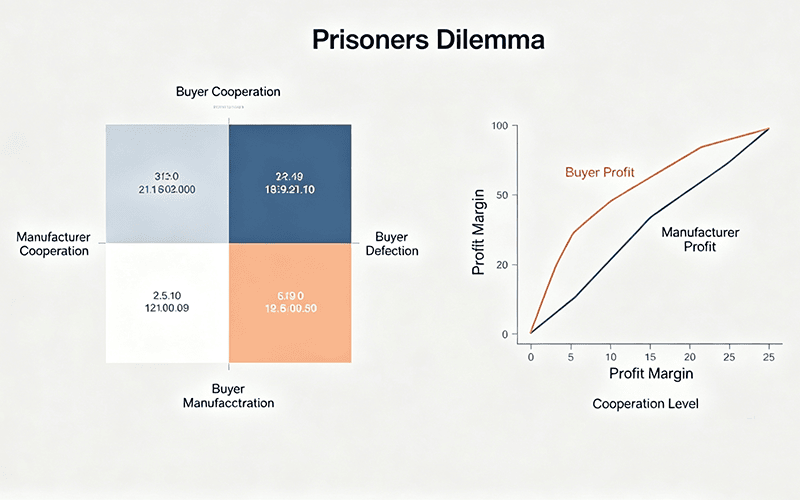
When the factory margin becomes extremely low, there is less room to absorb unexpected production costs, quality-control work, rework and after-sales problems.
This does not mean that every low-priced factory automatically produces poor-quality furniture. Efficient manufacturers can sometimes offer competitive pricing because of scale, automation, material purchasing power or optimized production processes.
The real warning sign is a quotation that appears significantly below the realistic market cost without a clear explanation for the difference.
In such cases, buyers should investigate whether the difference comes from genuine efficiency or from lower material specifications, simplified production processes, reduced quality control or unrealistic assumptions about the final product standard.
When Buyers Push Prices Too Far
When buyers focus almost exclusively on achieving the lowest possible factory price, the apparent short-term saving can create larger costs later.
A factory may accept the order because it wants the customer relationship, needs production volume or wants to keep workers and equipment busy. But if the economics of the order are too weak, maintaining the originally agreed quality can become difficult.
For the buyer, this creates two possible outcomes.
First, the buyer keeps the same selling price and enjoys a higher theoretical margin, but defective products, replacements and customer complaints begin to consume that additional profit.
Second, the buyer reduces the final selling price to compete in the local market. This may increase sales volume but can gradually position the brand toward a lower-price market segment.
When a 10% Lower Price Became More Expensive
We once worked with a customer who had previously purchased from another manufacturer.
He told us that our products had consistently high quality and almost no after-sales problems. However, another supplier offered prices more than 10% lower than ours.
At first glance, the lower quotation looked attractive. The buyer believed that even if a certain percentage of products had defects, the savings on the purchase price would still compensate for replacements or refunds.
We knew the competing factory had a similar production scale and a comparable cost structure. This made a price difference of more than 10% difficult to explain purely through manufacturing efficiency.
The customer eventually switched suppliers.
Over the following months, defective products and customer complaints increased. Replacement costs, refunds, logistics and customer-service work gradually consumed the additional margin created by the lower purchase price.
After approximately six to twelve months, the customer returned to us with his orders.
The lesson was simple: the cheapest purchase price had not produced the lowest overall cost.
Why Reasonable Factory Margins Can Benefit Buyers
A buyer does not need to accept an excessive factory margin. Professional sourcing still requires quotation comparison, negotiation and market research.
However, once a competitive and realistic market price has been established, leaving the manufacturer enough room to operate sustainably can improve the overall relationship.
A financially healthy supplier has more capacity to invest in production supervision, quality control, engineering follow-up, packaging improvements and after-sales support.
For buyers who plan to reorder regularly, this can be more valuable than saving a small percentage on the initial purchase price.
The objective should therefore be to find a price that is competitive for the buyer while remaining sustainable for the manufacturer.
Can Third-Party Inspection Replace a Healthy Supplier Relationship?
Some buyers believe that they can simply negotiate the factory price as low as possible and use a third-party inspection company to guarantee quality.
Independent inspection is valuable and can significantly reduce certain risks. However, inspection cannot replace the factorys responsibility for manufacturing quality.
Production supervision, process control, product debugging, packaging inspection and corrective actions all require cooperation from the manufacturer.
A pre-shipment inspection can identify defects before goods leave the factory, but it does not automatically solve problems that appear after products enter the market.
If the supplier has little economic incentive to support the buyer after shipment, the inspection company cannot provide the long-term after-sales service that the manufacturer itself must provide.
Does Paying a Fair Price Mean the Factory Will Keep Raising Prices?
Some buyers worry that accepting a manufacturers reasonable quotation will encourage the supplier to increase prices on every future order.
In a professional long-term relationship, this should not be the objective of either side.
Manufacturing costs can change because of raw materials, labor, energy, exchange rates, logistics and production volume. These changes should be discussed transparently rather than hidden behind arbitrary price increases.
Likewise, buyers should not assume that every factory quotation contains an enormous amount of negotiable profit.
The strongest sourcing relationship is based on a clear understanding of the cost structure, product specification, order volume and expected cooperation over time.
Does Higher Factory Profit Mean Better Production Quality?
It is important to clarify that factory profit margins do not automatically determine the positioning or specification of mass-production quality.
As long as an order provides the manufacturer with a sustainable operating margin, production should follow the agreed bulk-production standards. A higher profit does not automatically mean that the factory will use better materials or provide a higher product specification than agreed.
However, profit space can strongly influence the attitude toward after-sales service, production follow-up and long-term cooperation.
Factory service is closely connected to the sustainability of the business relationship. When buyers provide stable and sustainable business, manufacturers have a stronger incentive to take responsibility for production issues, solve problems quickly and maintain long-term cooperation.
On the contrary, when buyers continuously squeeze the factory margin to the lowest possible level, the supplier may view the order as a one-time transaction rather than a long-term partnership. In such circumstances, there may be less willingness to invest additional time and resources in after-sales support, even when the buyer represents a significant company.
The objective should therefore be to separate two things: product quality must be clearly defined and controlled, while supplier profitability should remain sustainable enough to support reliable production and long-term service.
How to Evaluate a Factory Quotation
Before choosing the lowest quotation, look at the complete economics of the supplier relationship.
- Compare the same product specification across several suppliers.
- Confirm materials, dimensions, finishes and quality standards before comparing prices.
- Ask why an unusually low quotation is significantly below the market range.
- Consider order volume and production efficiency when evaluating pricing differences.
- Understand what quality-control procedures are included in the quotation.
- Clarify packaging, spare parts, warranty and after-sales responsibilities.
- Calculate the potential cost of defects, returns and replacements.
- Evaluate the supplier for long-term reliability rather than only the first order price.
The Better Way to Negotiate With Chinese Manufacturers
Good negotiation is not about forcing the supplier to accept an unsustainable price. It is about creating a structure where both sides have a reason to protect the relationship.
- Research the market before negotiating.
- Provide clear product specifications and realistic quantities.
- Separate genuine cost reductions from reductions in product quality.
- Discuss annual or repeat-order potential honestly.
- Agree on measurable quality standards before mass production.
- Use inspections as an additional control rather than the only quality system.
- Keep communication transparent when problems appear.
- Build a supplier relationship around repeat business and mutual profitability.
The cheapest quotation can be the most expensive supplier relationship if quality problems and after-sales costs consume the initial savings.
Win-win cooperation is the core of long-term international trade.
There is no absolute unilateral profit in international trade. The price and quality relationship between buyers and manufacturers should not be treated as a zero-sum game in which one side can only benefit at the expense of the other.
Smart buyers will not blindly pursue the lowest purchasing price, while professional factories should not deliberately demand excessive margins.
A reasonable profit space for manufacturers should not automatically be viewed as an unnecessary cost. For long-term sourcing relationships, it can be an investment in product stability, production consistency, after-sales support and supplier commitment.
Balanced cooperation allows buyers to build stable customer relationships and protect their market reputation, while manufacturers can maintain standardized production and provide reliable service.
Ultimately, the strongest international sourcing relationships are those where both sides have a clear reason to protect the quality of the cooperation.
If you are searching for a long-term stable OEM supplier that focuses on transparent pricing, consistent bulk quality and complete after-sales support, we welcome you to send us your detailed requirements for a sincere and competitive quotation.

No. A lower quotation can be beneficial when it comes from genuine production efficiency, larger order volume or better purchasing power. However, an unusually low price can also indicate differences in materials, production processes or quality control.
Third-party inspection can reduce important quality risks, particularly before shipment, but it cannot replace factory-level process control or after-sales support. The manufacturer remains responsible for producing consistent goods and resolving problems after delivery.
Factories may offer aggressive pricing to win a new customer, secure production volume or enter a new market. Buyers should understand exactly what is included in the quotation and whether the same quality standard can be maintained during mass production.
No. Higher profit does not automatically mean better materials or better production. Quality should be controlled through clear specifications, approved samples, production standards and inspections. Sustainable profit mainly gives the manufacturer more room to maintain production and provide reliable service.
Start with clear specifications, realistic quantities and market research. Compare equivalent products rather than simply comparing headline prices. A professional negotiation should seek a competitive and sustainable price while protecting the agreed quality standard.
Consider material quality, production consistency, lead time, packaging, quality control, warranty, spare parts, communication, logistics, defect rates and after-sales support. These factors can have a much greater impact on the total cost of ownership than a small difference in the initial quotation.
Looking for a Stable OEM Furniture Manufacturing Partner in China?
Lohabour works with international buyers, wholesalers, hospitality projects, commercial developments and OEM programs. Our manufacturing capabilities cover upholstered furniture, wood furniture and metal furniture, with a focus on consistent production, quality control and long-term supplier relationships.
Read About Our Manufacturing