
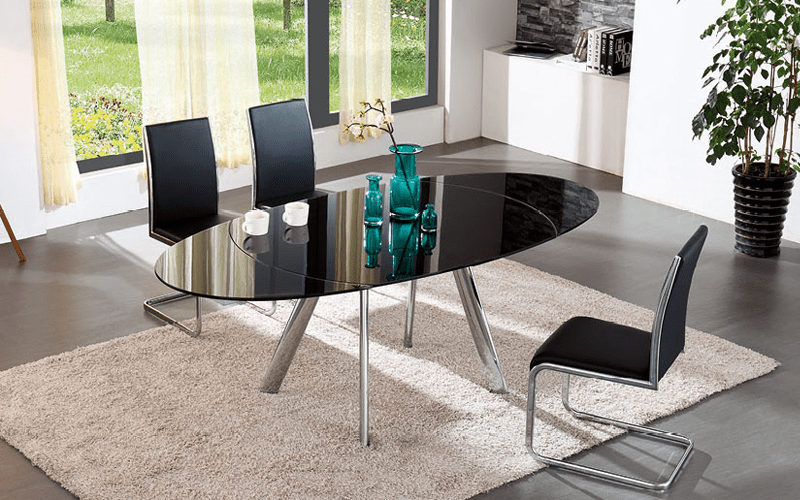
The European furniture market has witnessed growing demand for extendable dining tables, reflecting a broader shift toward versatile and space-efficient living environments.
Unlike conventional dining tables, extendable models allow consumers to adapt the size of the table according to the number of users and the available space. This combination of functionality, flexibility and design has made extendable dining tables an increasingly important product category for furniture retailers and distributors.
For international buyers sourcing from China, however, choosing the right product involves much more than comparing catalogue photos and factory prices.
Buyers need to understand the different extension mechanisms, materials, standard dimensions, customization possibilities and regional production strengths before selecting a supplier.
The Chinese furniture industry is highly diverse. Different production regions have developed different capabilities, cost structures and manufacturing specialties. Understanding these differences can help buyers choose a sourcing strategy that matches their target market and order requirements.
The right extendable dining table supplier is not necessarily the cheapest factory. It is the supplier whose production capabilities match your product, quantity and market requirements.
This guide explains the main types of extendable dining tables available from Chinese manufacturers and provides a practical framework for international buyers looking to develop or source this product category.
Understanding the Diversity of Extendable Dining Tables
Extendable dining tables are available in many different configurations. The first distinction buyers should understand is the extension mechanism.
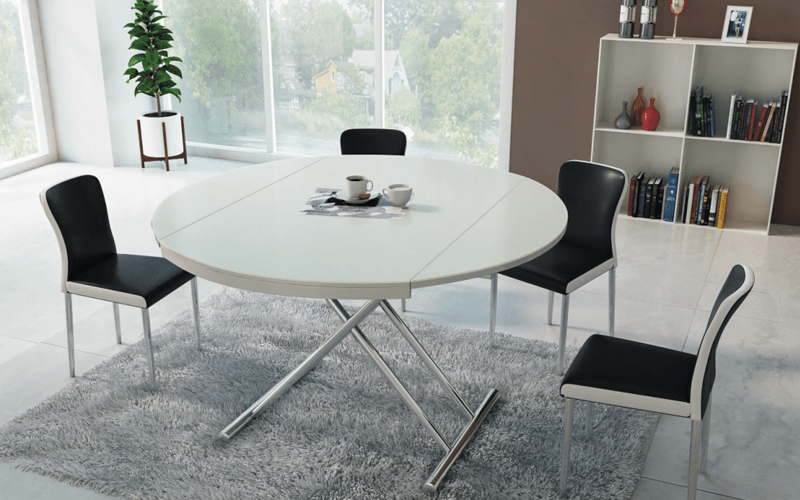
Middle-extension tables expand from the center of the tabletop. This mechanism allows the table to increase in length while maintaining a relatively balanced appearance when extended.
Dual-sided extension systems provide additional flexibility because the tabletop can expand from both sides. This can be useful when different seating configurations are required.
Single-sided extension tables use an extension mechanism concentrated on one side. This approach can be particularly useful for space-conscious environments where the table needs to remain compact when not in use.
Rotating extension systems use a more dynamic mechanism that allows the tabletop to transform into a larger configuration. These designs can create a strong visual selling point for modern furniture retailers.
The extension mechanism is therefore not simply a technical detail. It directly affects the appearance, usability, manufacturing complexity, durability and final price of the table.
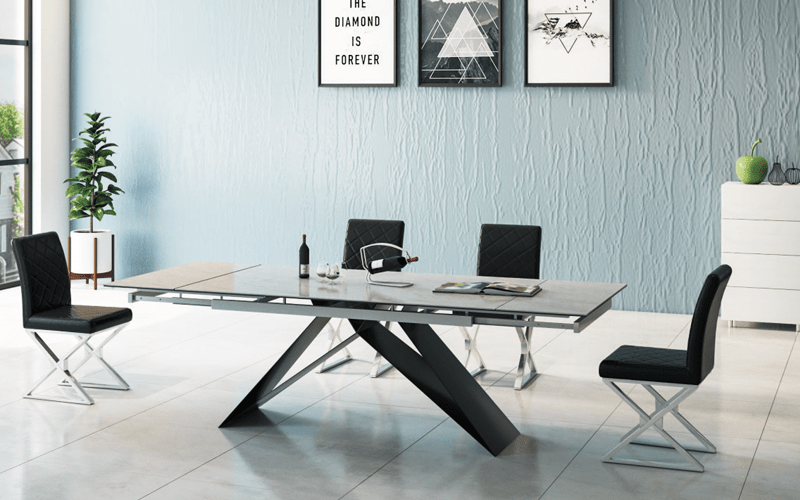
Choosing the Right Materials for Extendable Tables
Material selection plays a major role in the appearance, durability, weight and positioning of an extendable dining table.
Wood remains one of the most traditional choices. Wooden tabletops can create a warm and natural appearance while offering compatibility with a wide range of interior styles.
Ceramic surfaces are increasingly popular for modern dining furniture because they offer an elegant appearance and are relatively easy to clean. Ceramic can also create a premium visual positioning for higher-end furniture collections.
Glass provides a different aesthetic direction. Glass tabletops can create a lighter and more contemporary appearance and may be particularly suitable for modern or minimalist interiors.
The table legs and supporting structure also require careful consideration. Depending on the design, manufacturers may use solid wood, iron, fiberglass or other structural materials.
Leg material influences not only the appearance of the table but also its stability, total weight, transportation requirements and manufacturing cost.
For buyers developing their own furniture collection, material selection should therefore be defined before requesting supplier quotations. Otherwise, apparently similar products may actually have significantly different specifications and costs.
Understanding Standard Extendable Dining Table Dimensions
Extendable dining tables are produced in a wide range of dimensions to accommodate different room sizes and seating requirements.
Several size ranges are commonly found in the European market, including 130–190 cm, 130–200 cm, 160–240 cm, 180–260 cm and 200–300 cm.
The first measurement generally represents the compact length of the table, while the second represents its extended length.
These dimensions allow retailers to target different consumer groups. A compact 130 cm table, for example, can be positioned for smaller apartments, while a table extending toward 300 cm can serve larger dining rooms and families who regularly entertain guests.
Buyers should not evaluate dimensions based only on the closed position. The extended configuration, seating capacity, leg positioning and usable space around the table are equally important.
For commercial projects such as apartments, hotels or residential developments, dimensions should also be considered alongside room layouts and circulation requirements.
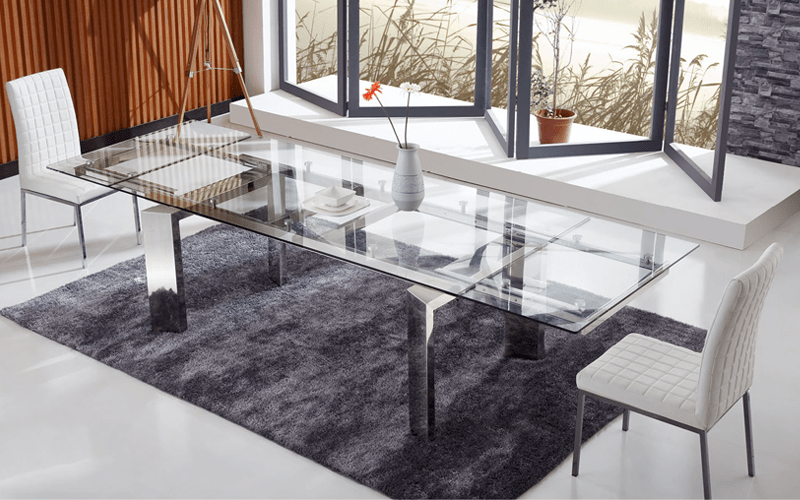
Why Custom Dimensions Can Create a Competitive Advantage
One of the major advantages of sourcing extendable dining tables from China is the possibility of customization.
Standard dimensions can work well for general retail distribution, but customized dimensions allow buyers to develop products specifically adapted to their target market.
A buyer may need to change the closed length, extended length, tabletop width or seating capacity to match a particular market or residential environment.
Customization can also include materials, colors, finishes, leg designs, extension mechanisms and packaging specifications.
For furniture brands, this flexibility can help create a differentiated product instead of selling exactly the same catalogue model as competing retailers.
For project buyers, customization can be even more important because furniture may need to fit specific architectural dimensions or interior design concepts.
However, customization should always be evaluated together with order quantity and production capability. A factory may technically be capable of producing a customized table but may not be commercially suitable for small-volume production.
Understanding Regional Production Dynamics in China
China does not have a single furniture production model. Different regions have developed different manufacturing strengths, and these differences can influence the products and suppliers available to international buyers.
The Northern market, particularly Hebei, is known for large-scale and cost-conscious manufacturing. Factories operating in this environment often focus on mass production and competitive pricing.
For buyers primarily interested in large quantities and straightforward product specifications, northern production bases can offer attractive cost advantages.
The Southern market, particularly Guangdong, has developed a different profile. Manufacturers in this region often place greater emphasis on product design, finishing quality, customization and flexible furniture supply chains.
Southern manufacturers may also be more suitable for buyers who need smaller production batches, multiple furniture categories or integrated dispatch from several product lines.
Understanding these regional differences allows buyers to search more efficiently instead of contacting manufacturers randomly across the entire country.
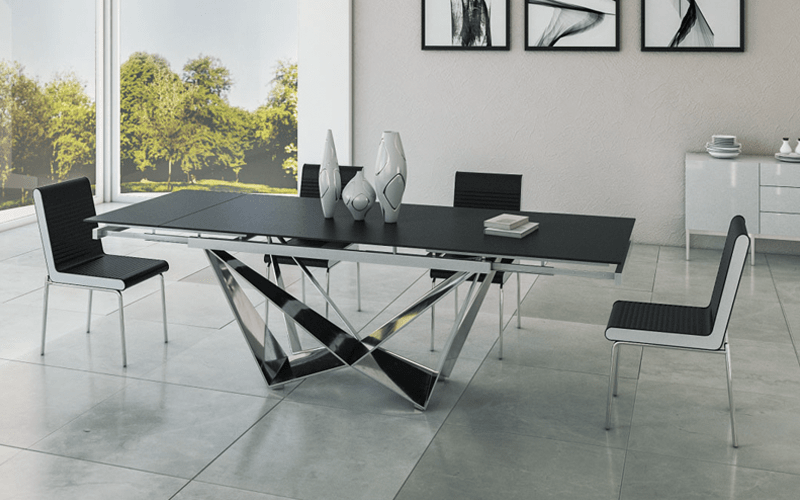
Which Chinese Production Region Is Right for Your Business?
There is no universally superior furniture production region. The correct choice depends on the buyer's objectives.
If your business requires large volumes of relatively standardized products and price competitiveness is the main priority, northern manufacturers can be worth investigating.
If your business requires more sophisticated design, customization, smaller quantities or coordination with other furniture products, manufacturers in Guangdong and the wider Southern China furniture ecosystem may be more appropriate.
The Southern production ecosystem can also be attractive for buyers who need to combine several furniture categories into one sourcing program. Integrated procurement can simplify logistics and reduce the complexity of coordinating multiple suppliers.
For personal use, boutique retail or small-scale business operations where product design and flexibility are important, a supplier capable of providing customization and design support may be more valuable than a factory offering the absolute lowest production cost.
The important principle is to match the supplier location and business model to your actual requirements rather than assuming that the cheapest production region is automatically the best option.
A Strategic Approach to Sourcing Extendable Dining Tables
Effective sourcing begins by clearly defining the product before searching for manufacturers.
First, determine the primary structural and surface materials you require. Decide whether your product should use wood, ceramic, glass, iron or a combination of materials.
Next, define the intended purpose and business scale. A private buyer, boutique furniture store, online retailer and large-scale project purchaser will have completely different sourcing requirements.
Once these parameters are clear, identify production regions and suppliers that specialize in the required product type.
Online sourcing platforms and furniture exhibitions can then be used to build a shortlist of potential manufacturers and suppliers.
Do not immediately place a large order after receiving an attractive quotation. Request samples first and evaluate the extension mechanism, surface finish, structural stability, materials and overall manufacturing quality.
For serious commercial sourcing programs, commissioning a third-party factory audit can also help verify the supplier's production capability, organization and business legitimacy.
Only after completing these evaluations should buyers proceed to detailed negotiations covering price, MOQ, customization, payment terms, packaging, production lead time and shipping.
How to Evaluate an Extendable Dining Table Supplier
A supplier's ability to produce an attractive sample does not automatically guarantee consistent mass production.
Buyers should examine the factory's experience with the specific extension mechanism they intend to purchase. Complex mechanisms require appropriate engineering, assembly and quality-control procedures.
The supplier should also be able to explain how the extension system is tested during production and how potential alignment, stability or mechanical problems are controlled.
Material specifications should be documented clearly. This includes tabletop materials, thickness, frame construction, leg materials, surface finishes and hardware.
Packaging is another important consideration because extendable tables contain moving components and can be relatively large. Packaging must protect both the tabletop and the extension mechanism during international transportation.
Finally, evaluate the supplier's communication and after-sales capability. A reliable manufacturer should be able to respond effectively when technical questions or product issues arise after shipment.
Using Online Platforms and Furniture Exhibitions
Online platforms are useful for identifying a large number of potential suppliers quickly, while furniture exhibitions provide the advantage of evaluating products and meeting suppliers in person.
Use online platforms to understand the range of available designs, materials and indicative pricing before creating your shortlist.
Furniture exhibitions can then be used to compare products directly, inspect finishing quality and discuss customization requirements with suppliers.
The best sourcing process combines both approaches rather than relying exclusively on either one.
After identifying potential suppliers, request samples and detailed technical information. If the order value is significant, consider arranging an independent factory audit before committing to production.
The objective is to gradually reduce uncertainty at each stage: first evaluate the product, then the supplier, then the production capability, and finally the commercial terms.
Define Your Extendable Dining Table Requirements
Before contacting Chinese suppliers, establish the exact product you want to source.
- Define the closed and extended table dimensions.
- Determine the required seating capacity.
- Choose the tabletop material.
- Define the structural and leg materials.
- Select the preferred extension mechanism.
- Specify colors and surface finishes.
- Determine whether customization is required.
- Define packaging requirements.
- Estimate your expected order quantity.
Evaluate Potential Chinese Suppliers
Do not select a manufacturer based only on catalogue photos or the lowest quotation.
- Check the supplier's experience with extendable dining tables.
- Confirm the actual manufacturing capabilities.
- Ask whether the supplier is a factory or integrated supplier.
- Request product samples.
- Test the extension mechanism.
- Verify materials and construction specifications.
- Evaluate finishing and structural stability.
- Check packaging quality.
- Ask about production lead time and MOQ.
- Consider a third-party factory audit for significant orders.
Build a Reliable China Sourcing Process
A structured sourcing process reduces product, supplier and logistics risks.
- Research suppliers online and through furniture exhibitions.
- Compare equivalent product specifications.
- Evaluate Northern and Southern China production options.
- Request comparable quotations from multiple suppliers.
- Test samples before mass production.
- Confirm customization requirements in writing.
- Agree on quality standards before production.
- Confirm payment and inspection conditions.
- Verify packaging and shipping requirements.
- Maintain clear communication throughout production.
Successful furniture sourcing starts with understanding the product you need, then finding the production region and supplier capable of delivering it consistently.
Sourcing extendable dining tables from China can offer international buyers access to a very wide range of designs, materials, mechanisms and customization possibilities.
However, successful procurement requires more than finding an attractive product at a competitive price. Buyers need to understand how the extension mechanism works, which materials are being used, what dimensions are required and whether the supplier has the technical capability to maintain consistent quality during mass production.
The regional structure of Chinese furniture manufacturing is also important. Northern production bases can be attractive for large-scale, cost-focused procurement, while Southern China and Guangdong can provide strong advantages for design-oriented products, customization, smaller batches and integrated furniture sourcing.
The right strategy therefore begins by defining the product and business requirements clearly. Once the specifications, quantities and target market are established, buyers can identify suitable production regions and build a shortlist of manufacturers and suppliers.
Samples should then be evaluated carefully before production, particularly for the extension mechanism, structural stability, materials and finishing quality. For larger commercial orders, independent factory audits and quality inspections can provide additional protection.
Ultimately, the objective is not simply to find the cheapest extendable dining table in China. The objective is to establish a reliable supply chain capable of delivering the right product, at the right quality and at a sustainable cost.
If you are looking for customized or bulk extendable dining tables manufactured in China, Lohabour can work with you to evaluate product requirements, materials, customization options and production solutions for your target market.
Chinese manufacturers produce many types of extendable dining tables, including middle-extension, dual-sided, single-sided and rotating-extension models. They are also available in different materials such as wood, ceramic and glass.
Common size ranges include approximately 130–190 cm, 130–200 cm, 160–240 cm, 180–260 cm and 200–300 cm. Exact dimensions can also be customized according to the buyer's requirements.
Yes. Depending on the manufacturer, buyers can customize dimensions, materials, colors, finishes, leg designs, extension mechanisms and other product details. Customization should be confirmed with the supplier before ordering.
There is no single best region for every buyer. Northern China can be attractive for cost-efficient mass production, while Guangdong and Southern China can offer stronger options for design, customization, smaller batches and integrated furniture sourcing.
Yes. Samples are particularly important for extendable tables because buyers need to evaluate the extension mechanism, alignment, stability, materials, finishing and overall construction before committing to mass production.
For significant commercial orders, a third-party factory audit can be useful for verifying production capabilities, factory organization, equipment and business information. It should be combined with product sampling and quality-control procedures.
The choice depends on your order volume and requirements. Buyers seeking highly customized products or large-scale production may benefit from direct factory cooperation, while smaller buyers may benefit from suppliers with broader product ranges and more flexible sourcing services.
Looking for Extendable Dining Tables Manufactured in China?
Lohabour works with international furniture buyers, wholesalers, retailers and project clients looking for customized and bulk furniture production in China. We can support product development, material selection, customization and manufacturing for different market requirements.
Discover Our Products