
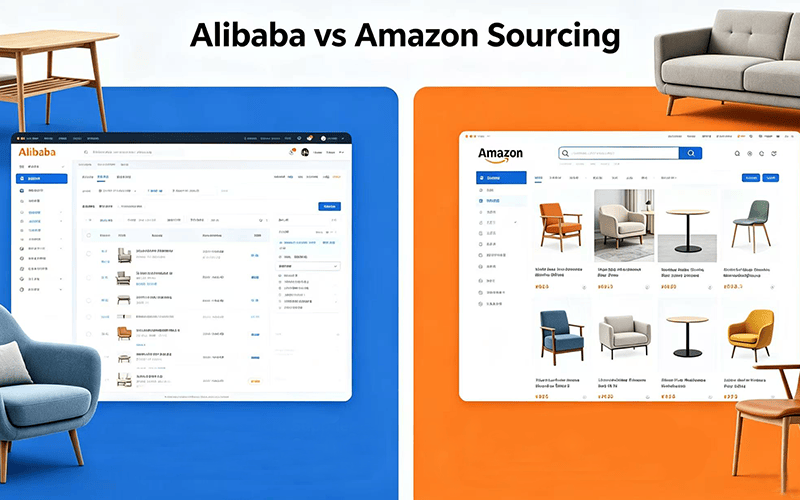
For most new sellers and small buyers, Alibaba is often discovered through Facebook ads, Google searches or other online channels. Many newcomers arrive with one simple objective: find Chinese suppliers that can offer prices significantly lower than B2C platforms such as Amazon.
The basic idea seems logical. If you buy directly from China, you remove middlemen and should therefore save money.
But furniture sourcing is more complicated than simply comparing the Alibaba product price with the retail price on Amazon.
The final cost of a furniture order depends on product specifications, production quantity, inland transportation, international freight, customs clearance, duties, warehousing and other logistics costs.
Understanding this complete cost structure is the key to knowing when Alibaba actually provides a meaningful cost advantage.
The Alibaba price is not your final cost. Your real savings begin when you understand the complete supply chain.
For new buyers, the biggest mistake is to focus entirely on finding a “factory” with the lowest quotation while ignoring the logistics structure behind the order.
In furniture sourcing, shipping and customs costs can represent a substantial part of the final landed cost. The right purchasing strategy therefore starts with logistics planning, not simply supplier searching.
Two Big Misunderstandings About Alibaba Suppliers
Before discussing how to save money on Alibaba, two common misunderstandings need to be clarified.
First, not every supplier listed on Alibaba is a factory.
Some companies are manufacturers, some are trading companies and others operate through a combination of manufacturing and external production resources.
Second, a factory price is not automatically lower than a trading company price.
For a new buyer, the more important question is not simply whether the seller owns a factory. The real question is why the final price is different and what is included in that price.
A trading company with strong purchasing volume may sometimes obtain competitive factory pricing. Conversely, a factory with low production efficiency, small order volumes or high overhead costs may not necessarily provide the lowest total price.
The important thing is therefore to compare equivalent products, specifications, quantities, quality standards and delivery conditions.
The assumption that “factory direct always means cheapest” is too simplistic for international furniture sourcing.
Alibaba vs Amazon: Understanding the Inventory Model
To understand Alibaba pricing, it is useful to compare it with the way Amazon sellers operate.
Amazon sellers can ship inventory to warehouses in advance. They must purchase or manufacture the goods, transport them, store them and eventually sell them to individual customers.
The retail price therefore needs to cover manufacturing costs, international transportation, fulfillment, storage, marketplace fees, customer service, inventory risk and profit.
The seller carries the risk of holding inventory before the final customer purchases it.
Alibaba suppliers face a different but related economic reality.
Whether you are purchasing from a factory or a trading company, a supplier cannot simply provide an extremely low unit price without considering production volume and inventory risk.
Large quantities allow production, packaging and logistics costs to be distributed across many units. This is one of the main reasons bulk purchasing can generate significantly lower unit costs.
For furniture buyers, the key lesson is that the Alibaba product price should never be compared with an Amazon retail price without considering the logistics and quantity differences between the two business models.
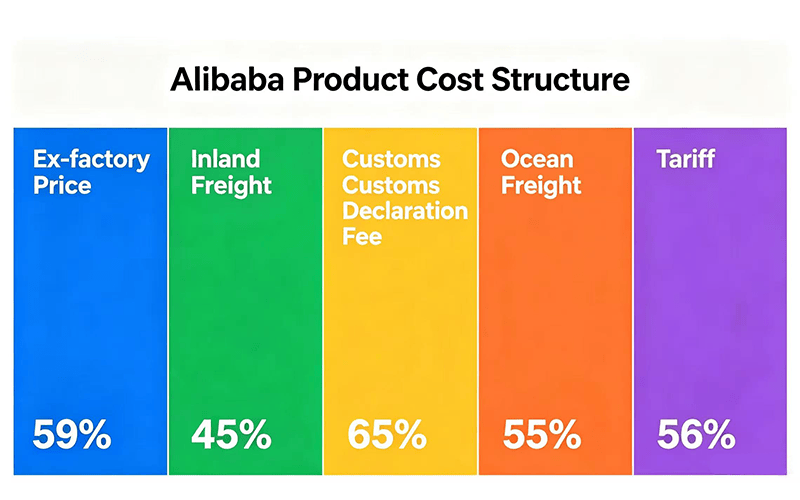
The Shipping Mistake New Buyers Must Avoid
One of the most common mistakes made by new Alibaba buyers is assuming that purchasing one piece must be cheaper than purchasing a large quantity.
For furniture, this is often completely wrong.
If a supplier does not operate an overseas warehouse and each order is shipped separately from China, every shipment may require its own logistics process, customs declaration and associated handling costs.
The customs and administrative cost of a shipment does not necessarily increase proportionally with the number of products inside the shipment.
A shipment containing one furniture set and a shipment containing one hundred units may require many of the same basic declaration and clearance procedures.
When these fixed or semi-fixed costs are allocated to a single product, the cost per unit can become extremely high.
This is why a single sofa purchased directly from China can sometimes have a surprisingly high landed cost even when the Alibaba product price appears extremely attractive.
New buyers should therefore calculate the complete landed cost rather than comparing product prices alone.
Why Full or Half Container Loads Can Dramatically Reduce Unit Costs
Furniture is bulky, which makes shipping efficiency particularly important.
For many furniture products, international freight, customs clearance and related logistics expenses can represent a significant percentage of the final landed cost.
When products are shipped individually, these costs are effectively attached to individual orders.
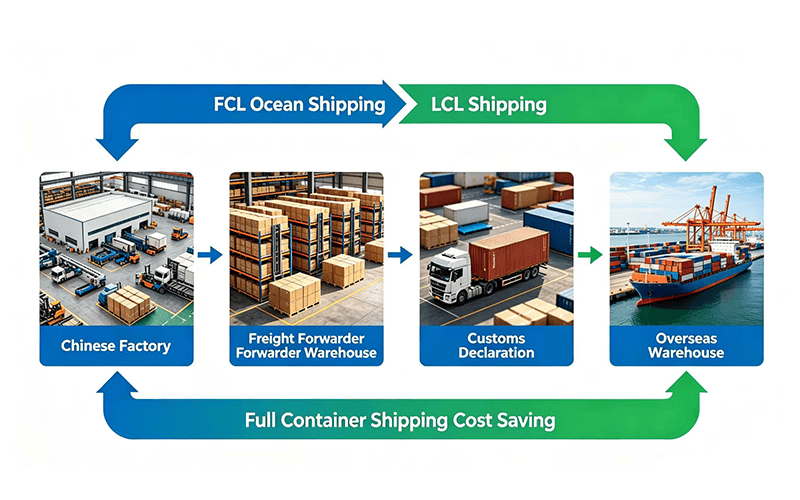
With a consolidated half-container or full-container shipment, logistics costs can instead be distributed across a much larger number of products.
This is similar to the economic logic behind large-scale inventory operations: fixed transportation and handling costs are spread across many units.
For buyers sourcing several furniture categories, consolidation can be even more valuable because sofas, dining tables, chairs, beds, cabinets and other products can potentially be shipped together when the logistics plan allows it.
The exact most economical shipment method depends on product volume, destination, customs requirements, container utilization and freight rates.
However, the basic principle remains simple: the more efficiently the shipment space and customs process are utilized, the lower the logistics cost can become on a per-unit basis.
When Is Alibaba Sourcing Truly Worthwhile?
If you only want to purchase one piece of furniture and the supplier has no overseas warehouse, no local inventory and operates entirely on a made-to-order basis, buying directly from China may not produce the lowest final cost.
The product price may look significantly cheaper than Amazon, but once international shipping, customs clearance, duties, handling and last-mile delivery are included, the advantage can become much smaller.
Alibaba becomes particularly meaningful when the buyer can use the advantages of international bulk purchasing.
This can include purchasing multiple furniture categories, combining products from several suppliers or filling a substantial portion of a container.
For many commercial buyers, wholesalers and furniture businesses, the objective is therefore not to buy one cheap item but to build a complete sourcing program.
The more products that can be efficiently consolidated into one shipment, the more opportunity there is to distribute logistics costs across the entire order.
This is why Alibaba is generally much more powerful as a B2B sourcing platform than as a simple alternative retail store for buying one inexpensive product.
Alibaba's Biggest Advantage: Customized Furniture
Beyond price, one of Alibaba's strongest advantages over conventional B2C platforms is customization.
Many Chinese furniture suppliers are able to manufacture products according to customer specifications rather than simply selling fixed inventory.
Buyers can potentially customize dimensions, materials, colors, finishes, upholstery, hardware and other product characteristics depending on the supplier's capabilities.
This is particularly valuable for furniture because room dimensions and design requirements vary significantly between projects and markets.
A sofa designed for one market may need different dimensions for another. A dining table may need a specific length. A hotel project may require a particular fabric, fire-rating requirement or finish.
B2C marketplaces generally focus on standardized products that are already manufactured and ready to ship.
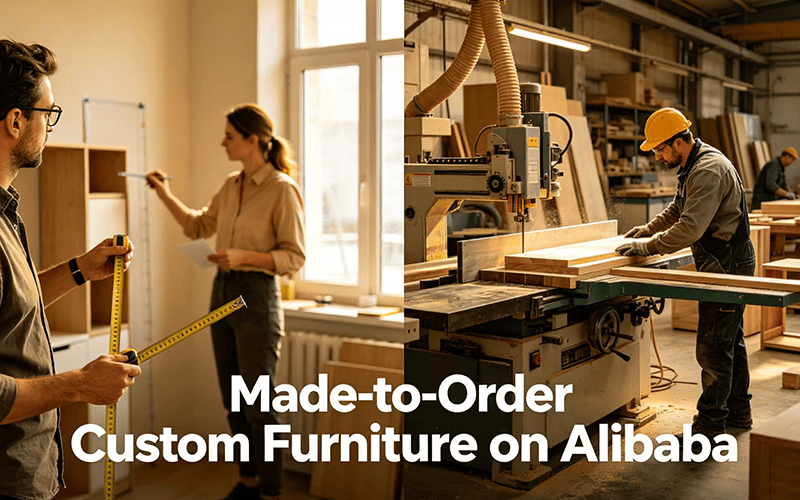
Alibaba can instead provide access to factories capable of producing made-to-order or customized furniture.
For this reason, the two most meaningful use cases for Alibaba furniture sourcing are large-volume purchasing and customized or non-standard furniture and building-material requirements.
How to Buy on Alibaba and Maximize Your Cost Savings
To maximize cost savings, new buyers should avoid asking individual suppliers to provide door-to-door shipping for every separate product.
For example, buying a sofa separately can create one shipment and one set of logistics and customs-related costs. Purchasing a dining table from another supplier separately can create another shipment and another set of charges.
If the products can instead be consolidated through a freight forwarder, the logistics structure becomes much more efficient.
The suppliers can deliver their finished goods to the forwarder's warehouse in China, where the cargo can be consolidated before international shipment.
This approach can significantly reduce duplicated logistics costs and make the total sourcing calculation much clearer.
The buyer should therefore think of the entire purchase as one supply-chain project rather than a collection of unrelated Alibaba orders.
The supplier produces the furniture, the forwarder consolidates the goods and the buyer manages the overall shipment and destination requirements.
Solve Shipping Before You Start Sourcing Factories
For furniture products, shipping and tariff costs can sometimes represent a very large part of the final landed cost.
This is why the first step for a new international buyer should not necessarily be finding factories.
The first step should be understanding how the goods will reach the destination market.
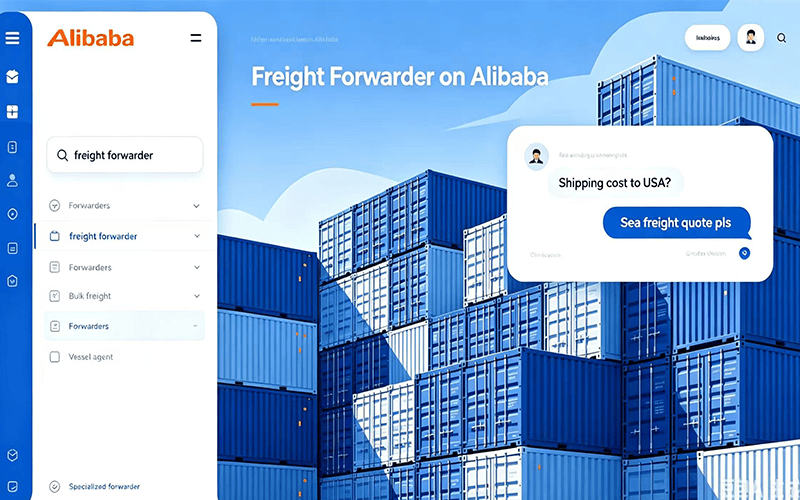
One practical approach is to search Alibaba for freight-forwarding companies serving your destination country and request several comparable quotations.
For example, a buyer can search for shipping services to the intended destination and ask forwarders for door-to-door transportation options, estimated customs costs and tariff budgets.
Once the logistics plan appears reasonable, the buyer can begin sourcing the furniture itself.
Suppliers can then be instructed to deliver finished products to the selected freight forwarder's warehouse in China.
The buyer can negotiate the furniture separately using an appropriate factory or FOB price plus the domestic transportation cost required to reach the forwarder's warehouse.
This separates product sourcing from international logistics and gives the buyer much greater visibility over the actual total cost.
How to Buy High-Quality Furniture on Alibaba
Alibaba should not be viewed only as a platform for finding the lowest price.
If your only objective is to buy the cheapest possible product, conventional B2C platforms may already provide a convenient solution because their sellers have already handled inventory, fulfillment and consumer logistics.
The stronger advantage of Alibaba is access to manufacturers and suppliers that can offer products at a more competitive cost while still meeting higher specifications.
For example, a sofa that sells for several thousand dollars in a local market may have a significantly lower factory price in China.
The potential saving does not come simply from removing a middleman. It comes from accessing the manufacturing source, purchasing according to the required quantity and organizing international logistics efficiently.
However, low factory pricing should never be confused with high quality automatically.
The buyer needs to define the required materials, dimensions, construction, upholstery, finish, packaging and quality standards before comparing supplier quotations.
Only then can different Alibaba suppliers be compared on an equivalent basis.
The Price–Quality Relationship on Alibaba
In general, higher-quality products tend to require higher production costs.
A supplier offering a significantly higher quotation may be using better materials, more complex production processes, better finishing or stronger quality control.
However, price alone is not proof of quality. Some suppliers can charge premium prices without delivering equivalent product quality.
For this reason, buyers should never evaluate suppliers solely by ranking quotations from lowest to highest.
Instead, clearly communicate your requirements to several suppliers and ask each one to quote against the same specification.
Compare material specifications, dimensions, construction details, finishing, packaging, production lead time and quality-control procedures alongside the price.
Samples are also valuable when the order is significant. A buyer should use the approved sample and documented specifications as the reference for mass production.
The objective is not to find the cheapest supplier. The objective is to find the supplier offering the best combination of quality, price, production capability and reliability for the intended business model.
Alibaba Furniture Sourcing Checklist
Before placing your first furniture order, make sure you understand the complete cost rather than focusing only on the supplier quotation.
- Define the exact product specifications before requesting quotations.
- Compare several suppliers using the same specifications.
- Do not assume every Alibaba supplier is a factory.
- Do not assume factory-direct automatically means the lowest price.
- Ask whether products are standard or customized.
- Calculate the complete landed cost, not just the Alibaba price.
- Understand international freight and customs requirements.
- Consider consolidating products from multiple suppliers.
- Arrange a reliable freight forwarder before production when possible.
- Use samples and clear specifications to control product quality.
- Consider inspection before shipment for significant orders.
- Evaluate suppliers on quality, reliability and total cost — not price alone.
How to Avoid Unnecessary Alibaba Shipping Costs
Furniture is bulky and logistics can become expensive quickly. Plan the shipment before ordering individual products.
- Avoid separate door-to-door shipments for every supplier when consolidation is possible.
- Request several freight-forwarder quotations.
- Estimate customs duties and destination charges before ordering.
- Choose a warehouse where suppliers can deliver their finished goods.
- Consolidate multiple suppliers into one shipment where practical.
- Use half-container or full-container shipping when the cargo volume justifies it.
- Confirm warehouse receiving requirements with the forwarder.
- Coordinate supplier production schedules with the planned loading date.
- Calculate the final landed cost per product after logistics.
Alibaba is not simply a place to find cheaper furniture. Its real advantage is combining factory access, bulk purchasing, customization and efficient international sourcing.
For new furniture buyers, Alibaba can provide significant sourcing opportunities — but only if it is used as a B2B supply-chain platform rather than simply as an online shopping website.
The biggest mistake is to look at a low product price and immediately assume that the final cost will also be low.
Furniture is bulky, international shipping is expensive and customs-related costs can become significant when products are shipped individually. A product that appears dramatically cheaper than Amazon can lose much of that advantage once freight, customs, duties and last-mile delivery are included.
This is why experienced buyers solve the logistics structure first.
By identifying a suitable freight forwarder, understanding the destination costs and arranging a warehouse for supplier deliveries, buyers can consolidate products from multiple Chinese suppliers into a more efficient international shipment.
The other major advantage of Alibaba is customization.
Instead of accepting fixed dimensions, colors and designs, buyers can work directly with Chinese manufacturers to develop products according to their own market requirements. This can be particularly valuable for furniture businesses, hospitality projects, commercial developments and private-label brands.
Quality should also remain a central part of the sourcing strategy.
The objective is not to find the supplier with the lowest quotation. It is to compare suppliers using identical specifications and identify the best balance between product quality, production capability, price, delivery and long-term reliability.
If your sourcing requirements involve significant volumes and high-quality products, the next step can be to go beyond online supplier selection and evaluate manufacturers directly in China.
Visiting factories, inspecting production capabilities and meeting suppliers in person can provide information that cannot always be obtained from Alibaba listings alone.
This is particularly important when building a long-term furniture sourcing relationship rather than making a one-time purchase.
No. Alibaba includes manufacturers, trading companies and other types of suppliers. Buyers should evaluate the supplier based on production capability, product quality, communication, customization capacity and total cost rather than assuming that factory-direct automatically means cheaper or better.
No. Alibaba may have a much lower product price, but international freight, customs clearance, duties, handling and last-mile delivery can significantly increase the final landed cost. Alibaba provides the strongest advantage when the buyer can use bulk purchasing, consolidation or customization.
It can make sense for customized or difficult-to-find products, but a single-item order may not provide the expected cost advantage because international logistics and customs costs are spread over only one product.
The best method depends on cargo volume, destination and product characteristics. For multiple furniture products, consolidated shipping, half-container loads or full-container loads can often distribute logistics costs more efficiently than individual shipments.
Many Chinese furniture suppliers offer customization, although the exact capabilities vary by manufacturer. Depending on the factory, buyers may be able to specify dimensions, materials, finishes, colors, upholstery, hardware and other design requirements.
Send the same detailed specifications to multiple suppliers and compare their quotations, materials, construction, finishing, packaging, lead times and quality-control procedures. Comparing only the headline price can produce misleading results.
Clearly define the product specification, request samples for important orders, approve a reference sample before mass production and consider independent quality inspection before shipment. The more precise the requirements, the easier it is to control production quality.
For significant or long-term sourcing programs, visiting factories can be very valuable. An on-site visit allows buyers to evaluate production capacity, quality-control systems, factory organization and the supplier relationship more directly than an online listing can provide.
Discover Furniture Manufactured in China
Lohabour develops and manufactures upholstered furniture, wood furniture and metal furniture for international buyers, wholesalers, hospitality projects, commercial developments and OEM programs. Explore our product range and discover the possibilities of direct furniture sourcing from China.
Discover Our Products