

When international customers purchase products from China — whether small accessories, large furniture, bulk orders or small-batch orders — delivery delays have always been one of the biggest pain points in China-based sourcing.
Many buyers believe suppliers intentionally provide unrealistic production times and deliberately hold up shipments. However, the reality is more complicated.
Unstable delivery schedules can result from the relationship between buyers and suppliers, complex upstream supply chains, outsourced processing, factory production management and the way international shipments are organized.
Understanding these root causes is important because the solution is not simply to demand a shorter lead time. Buyers need to create a purchasing and logistics process that gives suppliers a clear production and loading schedule while maintaining sufficient control over quality and delivery.
A reliable delivery schedule is created by both supplier discipline and buyer planning.
This article explains the main reasons Chinese suppliers experience delivery delays and the practical measures international buyers can take to reduce these risks.
The objective is not simply to blame suppliers when shipments are late, but to build a sourcing system where production, inspection, payment, warehousing and loading are coordinated from the beginning.
Why Chinese Suppliers Sometimes Delay Production
One important cause of delivery delays comes from the prisoner's dilemma between suppliers and buyers.
In the past, many Chinese suppliers experienced situations where customers paid deposits but later canceled orders, requested full refunds or delayed container loading because they were waiting for goods from other suppliers for consolidated shipments.
When finished goods remain in storage for an extended period, the manufacturer faces capital being tied up, additional warehouse costs and extra labor expenses.
After experiencing these situations repeatedly, suppliers naturally become more cautious. Some manufacturers prefer to postpone formal production until the buyer has confirmed a firm shipment plan.
This reactive production habit can create delays even when the supplier does not intend to act dishonestly.
There are, of course, unethical suppliers who deliberately delay production after receiving deposits. A small number may use customer funds for cash-flow turnover or other purposes and postpone production for days or weeks.
However, deliberate bad-faith delays should be distinguished from the much more common situation in which suppliers are responding to uncertainty about the buyer's final order, loading or consolidation schedule.
For buyers, understanding this distinction is important because the solution to supplier uncertainty is often better planning and communication rather than simply demanding an earlier production date.
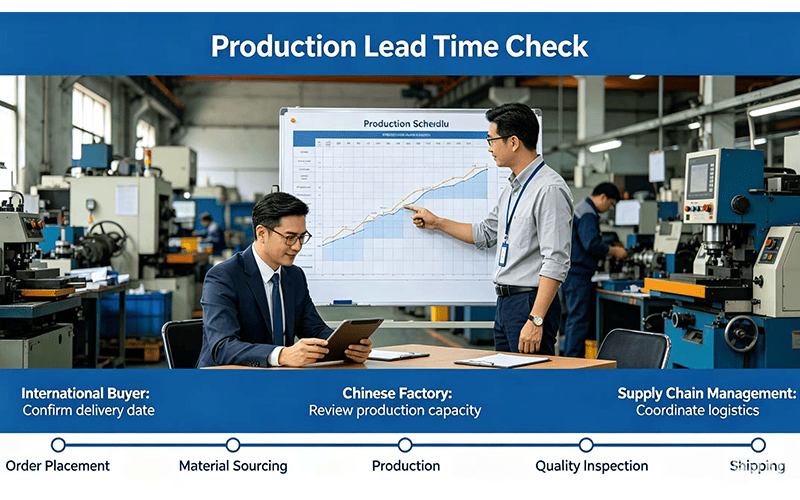
Why Complex Chinese Supply Chains Create Delivery Delays
A second major cause of production delays is the complexity of upstream and downstream supply chains.
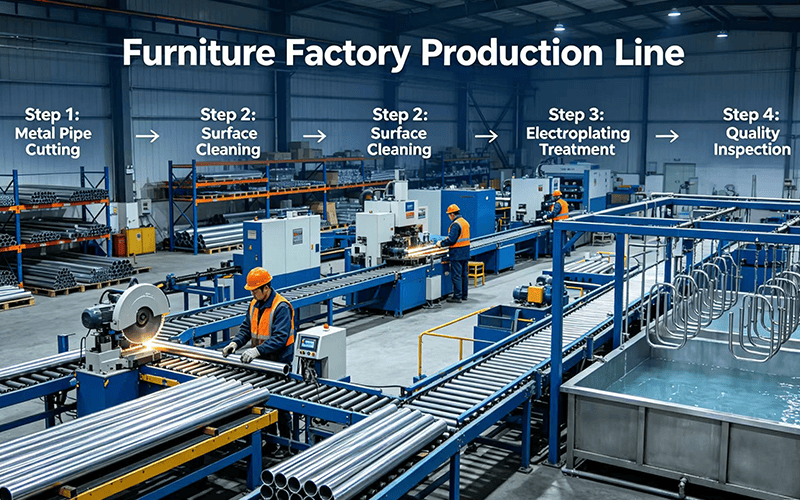
This is particularly obvious in the furniture industry, where a finished product may require several specialized processes before it is ready for shipment.
For example, consider a metal dining table manufactured using iron tubing. The production process may include pipe cutting, pipe bending, welding, polishing, grinding, surface treatment and electroplating.
Not every factory performs all of these operations internally. A manufacturer may rely on external processing plants for bending, polishing or electroplating.
These outsourced suppliers often have their own production schedules and order backlogs.
Even if the main factory completes the early stages of production on time, a delay at an external processing supplier can hold the entire order.
This creates an important distinction between factory lead time and real supply-chain lead time. The factory may believe it can manufacture the product within a certain number of days, but the complete production chain may require significantly more time.
For buyers, understanding which processes are outsourced is therefore essential when evaluating a supplier's promised delivery date.
How Factory Order Scheduling Can Extend Lead Times
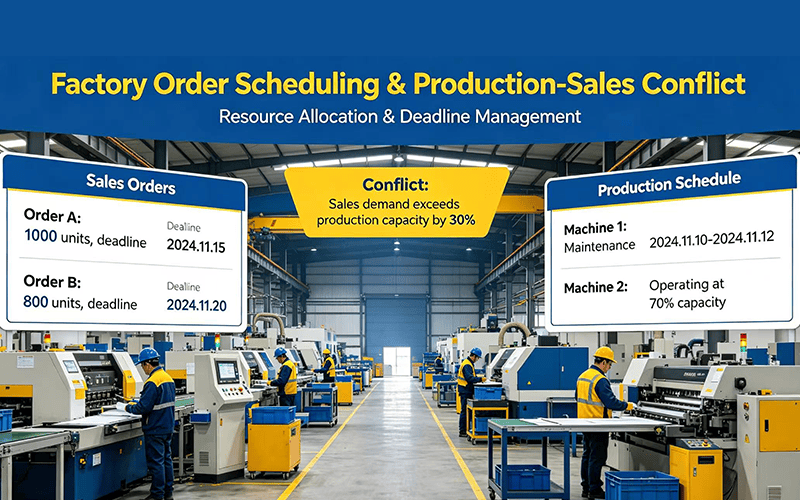
A third cause of unstable delivery schedules comes from factory-internal order scheduling.
Many Chinese factories operate in highly competitive markets where factory owners want to accept as many orders as possible in order to keep production lines active.
Even when individual orders have relatively low profit margins, factories may accept them because empty production capacity can also create significant financial pressure.
This can create an order-insertion problem.
Urgent orders from important or demanding customers may suddenly be inserted into an existing production schedule. Orders from buyers with more flexible shipment dates can then be pushed backward.
The factory may describe this as treating customers equally, but in practice it can produce significant differences between the originally promised lead time and the actual production schedule.
There is also an internal conflict between sales and production departments.
Sales teams naturally focus on customer satisfaction and want to accept orders whenever possible. Production teams, however, are often focused on efficiency, production batches, labor utilization and minimizing setup or material waste.
For this reason, small-batch orders may sometimes receive lower scheduling priority than larger production runs.
This permanent tension between sales requirements and production efficiency can become a major source of delivery delays.
How to Select Suppliers That Can Actually Meet Your Delivery Schedule
After understanding the root causes of delivery delays, the first practical step is to select reliable suppliers before placing the order.
A trustworthy supplier should have a realistic understanding of its production capacity, communicate clearly about lead times and take contractual commitments seriously.
An unreliable supplier may provide an attractive delivery date simply to win the order, even when its production schedule cannot realistically support it.
For this reason, pre-order communication is essential.
Before confirming an order, buyers should discuss production capacity, current factory workload, outsourced processes, material availability, estimated completion dates and the intended loading schedule.
Buyers should also avoid treating a supplier's verbal promise as the only delivery-control mechanism.
The agreed production and shipment conditions should be documented in the purchase contract or purchase order so that both sides have a clear reference point.
The more clearly the buyer communicates the required delivery date and shipment process before production begins, the easier it becomes for the supplier to organize its production resources.
Use Inspection Before Balance Payment to Maintain Production Discipline
Payment structure can also influence the buyer's control over the production process.
For suitable orders, buyers can establish clear contractual conditions stating that the final balance will only be paid after the finished products have been inspected and approved according to the agreed specifications.
This does not mean that buyers should simply refuse payment or create unnecessary financial pressure on suppliers.
The purpose is to create a transparent process in which production completion, quality inspection and final payment are clearly connected.
Product revisions can also create additional production time. If specifications, dimensions, finishes or quantities change after production has started, the original delivery schedule may no longer be realistic.
For this reason, buyers should finalize product details before production and clearly document any approved revisions.
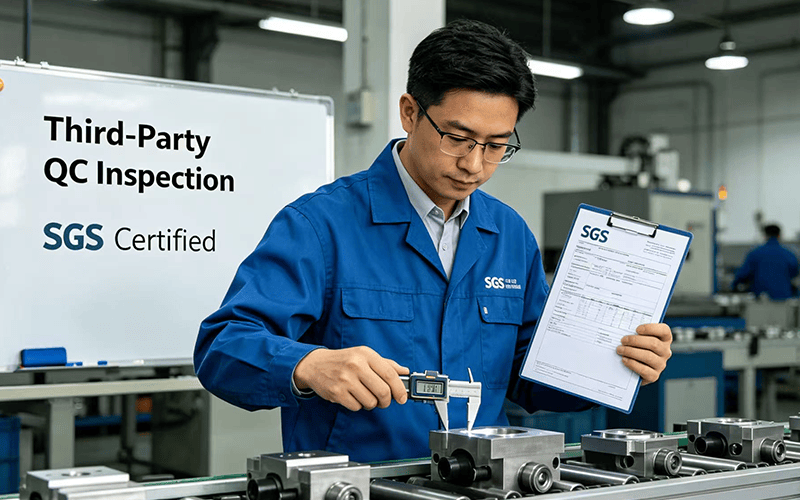
Where appropriate, independent third-party QC inspectors can provide an additional layer of verification before the balance payment or shipment.
The inspection should be performed against clearly agreed specifications rather than subjective expectations.
Give Suppliers a Clear Loading Plan to Reduce Delivery Anxiety
One of the most effective ways to reduce passive delivery delays is to give suppliers confidence that the goods will be collected as soon as production is completed.
This becomes particularly important when goods from several suppliers are being consolidated into one container.
If a supplier does not know when the container will be loaded, it may hesitate to complete production too early because finished goods could remain in the factory warehouse for an uncertain period.
International buyers should therefore communicate the loading plan to all suppliers as early as possible.
The freight forwarder should also be informed about the expected warehouse admission date before production is completed.
Where the forwarder provides a free warehouse-storage period, buyers can use that period strategically to reduce the uncertainty created by consolidated shipments.
For example, if suppliers know that finished goods can be delivered to the designated warehouse and remain there for a defined free-storage period, they have less reason to wait for every other supplier to finish production before releasing their own goods.
This creates a much clearer connection between factory completion, warehouse delivery and final container loading.
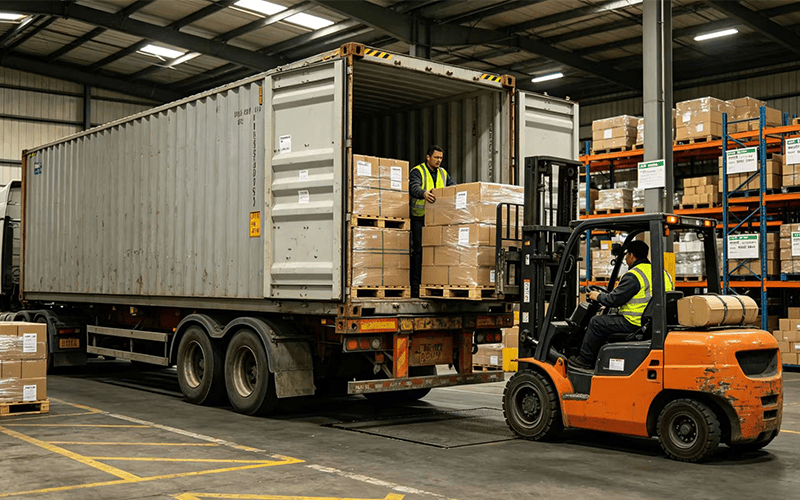
Why Buyers Must Control Their Own Ordering Rhythm
International buyers also have an important responsibility in controlling delivery schedules.
Buyers should avoid placing impulsive last-minute orders after casually asking a supplier for an estimated lead time.
A supplier's initial delivery estimate may be based on incomplete information about product specifications, order quantity, current production capacity and the required shipment method.
Before placing the order, buyers should confirm all product details and consolidate purchasing requirements whenever possible.
Centralized ordering makes it easier to establish a realistic production schedule and coordinate warehouse entry with the freight forwarder.
It also reduces the number of unexpected production requests that factories need to insert into their existing schedules.
If a supplier cannot realistically meet the required delivery date, the buyer should make that decision before production begins rather than hoping the factory will somehow accelerate the order later.
China has a large manufacturing ecosystem with many alternative suppliers. When a factory cannot meet a critical deadline, replacing the supplier may sometimes be more effective than repeatedly pressuring the same factory to accelerate production beyond its realistic capacity.
Build Production, QC and Shipping Into One Timeline
The most effective way to manage Chinese supplier lead times is to stop treating production, quality inspection and logistics as separate activities.
They should be considered as one integrated timeline.
The buyer should first establish the required final loading date and then work backward through warehouse admission, inspection, packaging, production completion and raw-material preparation.
This reverse-planning approach provides the factory with a clear target instead of an isolated production deadline.
For consolidated shipments, the timeline should also account for the different production schedules of each supplier.
The buyer should know which suppliers are expected to finish first, which goods require external processing and which products are likely to become the critical path for the shipment.
Regular progress updates can then be used to identify problems before they become shipment delays.
This approach transforms delivery management from a last-minute reaction into a controlled sourcing process.
How to Reduce Chinese Supplier Lead-Time Risk
Before placing the order, make sure the supplier and shipment conditions are clearly understood.
- Verify the supplier's production capacity and current workload.
- Confirm whether any production processes are outsourced.
- Ask about current raw-material availability and potential bottlenecks.
- Confirm the realistic production lead time rather than accepting an optimistic sales estimate.
- Finalize product specifications before production begins.
- Confirm quantities, finishes, packaging and quality standards in writing.
- Agree on the expected production completion date.
- Agree on the required warehouse delivery or loading date.
- Document important delivery and inspection conditions in the purchase contract.
How to Manage Consolidated China Shipments
When goods come from several suppliers, coordination becomes just as important as factory production.
- Confirm the final container loading date in advance.
- Tell every supplier about the intended loading schedule.
- Coordinate warehouse admission with the freight forwarder.
- Use available free-storage periods strategically.
- Avoid making one supplier wait indefinitely for another supplier to finish.
- Arrange QC inspection before final shipment where appropriate.
- Track production progress before the expected completion date.
- Identify the supplier that represents the critical path for the shipment.
- Keep backup suppliers available for urgent or time-critical orders.
The best way to avoid shipment delays is to control the entire timeline before production begins.
Delivery delays from Chinese suppliers are rarely caused by simple dishonesty.
Although unethical suppliers do exist, most delivery problems come from a combination of buyer-supplier uncertainty, complex outsourced supply chains, factory order scheduling, production priorities and poor shipment planning.
For international buyers, understanding these causes is the first step toward controlling the problem.
The most effective approach begins with careful supplier selection. Buyers should evaluate whether a supplier has realistic production capacity, understand which processes are outsourced and establish clear delivery expectations before the order is confirmed.
The second step is to create a clear contractual and quality-control structure. Product specifications should be finalized before production, delivery requirements should be documented and, where appropriate, final payment can be connected to an independent inspection of the finished goods.
The third step is to eliminate supplier uncertainty around loading. When several factories are involved in one consolidated shipment, suppliers should receive a clear loading plan and warehouse delivery schedule. Proper coordination with the freight forwarder can significantly reduce the tendency for suppliers to wait for other factories before releasing finished goods.
Finally, buyers need to control their own ordering rhythm. Last-minute purchasing decisions, constantly changing specifications and uncertain consolidation plans can create production delays even when the supplier is otherwise reliable.
A stable China sourcing process is therefore not based on finding a supplier who promises an impossibly short lead time. It is based on building a realistic system in which production, inspection, payment, warehousing and shipment are coordinated from the beginning.
By combining reliable supplier selection, clear contractual requirements, independent quality control, transparent loading plans and disciplined purchasing schedules, international buyers can significantly reduce delivery risk and build a much more stable long-term supply chain with Chinese manufacturers.
Delivery delays can result from uncertain buyer shipment plans, outsourced production processes, factory scheduling conflicts, urgent orders being inserted into production, material shortages and poor coordination between production and logistics. Not every delay is caused by supplier dishonesty.
Some unethical suppliers may deliberately delay production, but many delays are caused by production scheduling, outsourced processes or uncertainty about when the buyer will collect the goods. Buyers should investigate the specific cause rather than assuming every delay is intentional.
Agree on a realistic delivery date before production, document it in the purchase contract, finalize specifications early and provide a clear loading plan. Regular production follow-up and appropriate inspection and payment conditions can provide additional control.
When several suppliers are contributing goods to one container, some factories may hesitate to finish or release their products because they are waiting for other suppliers or are uncertain about the final loading date. Clear warehouse and loading arrangements can reduce this uncertainty.
Independent QC inspection can be valuable, particularly for international buyers who cannot easily visit the factory. It allows finished products to be checked against agreed specifications before shipment and can provide an additional layer of quality control.
The appropriate lead time depends on the product, quantity, factory capacity, outsourced processes, season and shipping method. Instead of using one universal number, buyers should establish the final loading date and work backward through production, inspection, warehouse delivery and logistics requirements.
First identify the actual bottleneck and determine whether the delay can realistically be recovered. If the deadline is critical and the supplier cannot provide a credible recovery plan, consider alternative suppliers or production arrangements rather than repeatedly extending the shipment schedule.
Looking for a Reliable Furniture Manufacturing Partner in China?
Lohabour works with international buyers, wholesalers, hospitality projects, commercial developments and OEM programs. Our manufacturing approach combines production planning, quality control, supplier coordination and long-term cooperation to help international buyers manage complex China sourcing projects.
Read About Our Manufacturing