
If you import furniture or other products from China regularly, you may hold a common misunderstanding: as long as you place orders, big or small, simple or complex, you are automatically a highly valuable customer to your suppliers.
In reality, Chinese manufacturers evaluate buyers very carefully. Many overseas buyers only visit China once or twice and may have limited experience dealing directly with different factories. Their perception of Chinese manufacturing can sometimes remain based on outdated assumptions about extremely low labour costs, raw materials and product prices.
This mindset can easily lead to incorrect expectations, difficult negotiations and unnecessary business conflicts.
How Chinese factories see you as a buyer can directly influence the way they price, prioritize and support your orders.
This article looks at the real customer profile from the perspective of Chinese manufacturers, covering buyer evaluation, payment terms, negotiation, business relationships, customized production and cooperation between different factories.
Understanding these factors can help overseas buyers source furniture from China more realistically, negotiate more effectively and build stronger long-term supplier relationships.
Factories Judge Buyers At First Sight: Appearance, Company Information & Order Strength
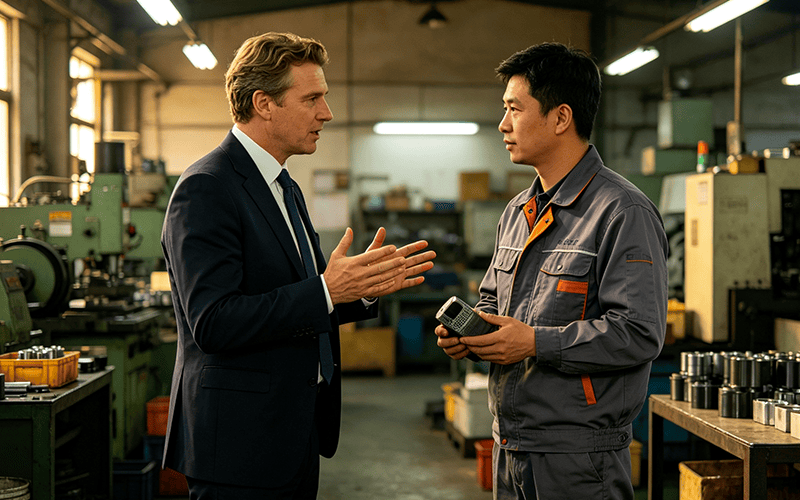
Chinese suppliers can quickly form an initial opinion about a buyer within the first few minutes of a meeting. Appearance, communication style, company information and the way an order is presented can all influence that first impression.
The importance of this first impression depends greatly on how experienced the factory team is. New salespeople may be impressed by expensive clothing, impressive corporate introductions or claims about company size. They may even try to obtain unusually low prices internally because they believe they are dealing with an important customer.
Experienced factory managers and owners, however, have usually seen these situations many times before. They understand that impressive presentations and company claims mean very little without real purchasing potential.
For most manufacturers, two factors carry much more weight: realistic order volume and favorable payment conditions. A buyer offering substantial order quantities and reliable payment terms is naturally more attractive than a buyer offering complicated production requirements with very small quantities.
If you cannot offer either significant volume or attractive payment conditions while simultaneously requesting complicated production processes, you are unlikely to be treated as a premium customer by an experienced manufacturer.
External appearance and corporate presentation can create a good first impression, but they rarely replace actual purchasing power. Experienced factory leaders generally reduce prices because of real business potential, not because a buyer looks wealthy or claims to represent a large company.
Payment Terms & Bargaining: Two Sides Of The Same Coin
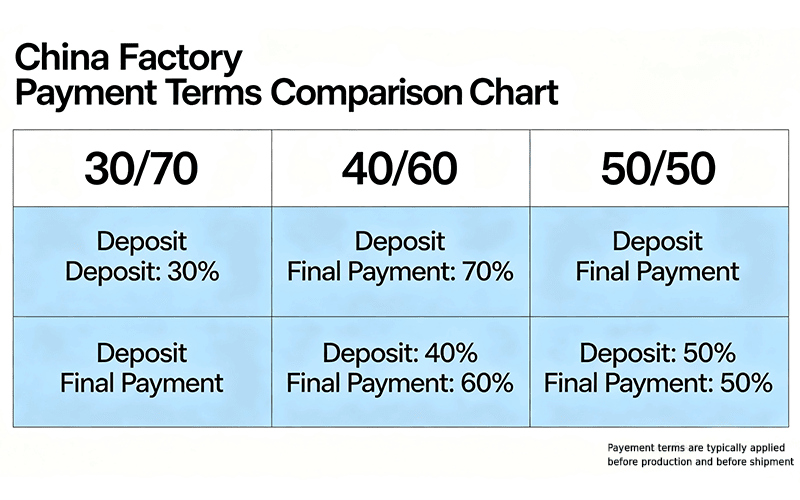
Many first-time visitors to China are unfamiliar with mainstream payment structures used by Chinese manufacturers. Depending on the industry and supplier, arrangements such as 30/70 or 40/60 deposits and balances are common starting points for discussion.
A buyer from a country where suppliers normally require 100% payment before production may see a 50/50 arrangement as an excellent deal. From the Chinese supplier's perspective, however, receiving 50% upfront may already represent favorable payment security.
The same principle applies to price negotiation. Buyers who accept the first quotation immediately and barely negotiate may be considered easy to communicate with. However, this can sometimes create an unintended signal that the buyer has limited knowledge of the market.
If you select a factory without comparing market prices, product quality and production capability, accepting an above-market quotation may leave you vulnerable to higher prices on future orders.
On the other hand, if you conduct proper market research, compare several manufacturers, evaluate quality and then select a factory offering a fair price and stable production capability, your negotiation behaviour communicates professionalism rather than weakness.
The important distinction is therefore not whether you negotiate aggressively. It is whether your purchasing decisions are based on real market knowledge.
China's Guanxi Culture: Hidden Costs Behind Dinners & Airport Pickups
China's business culture places considerable importance on personal relationships, often referred to as guanxi. Domestic business relationships are frequently strengthened through meals, personal introductions and informal meetings.
Chinese suppliers may use the same approach with overseas buyers. Factories can arrange airport pickups, local transportation, factory visits, dinners and detailed schedules in an effort to build a personal relationship before formal cooperation begins.
For a buyer, these activities can feel like valuable hospitality. From the factory's perspective, however, they involve real costs: transportation, meals, staff time and management resources.
Manufacturers do not normally operate at a loss. These expenses therefore need to be recovered somewhere within the overall business relationship, especially when the supplier invests significant resources into attracting a buyer.
Some overseas buyers may take advantage of hospitality and small benefits while ultimately choosing another supplier purely because that supplier offers a lower quotation. This can create frustration for the original factory and may encourage suppliers to recover their costs elsewhere.
The practical lesson is not that buyers should reject hospitality. Rather, buyers should understand the difference between professional relationship building and excessive attention that creates unnecessary costs.
A manufacturing-focused supplier may be less interested in elaborate receptions and more interested in discussing specifications, quantities, quality standards, production schedules and long-term cooperation.
Custom Production & Cross-Factory Cooperation: Manufacturers Need Real Commitment
One of the most important questions for overseas furniture buyers is whether Chinese factories will completely adapt their production processes to customized requirements.
The answer is usually: only to a certain extent.
Most manufacturers can adjust product dimensions, materials, colours, finishes and appearance within the capabilities of their existing production system. However, they are unlikely to rebuild production lines or create completely dedicated workshops for a buyer without significant commercial commitment.
What does meaningful commitment look like? Depending on the product and factory, it can include substantial annual order volumes, formal purchase orders, predictable demand and secure payment conditions such as a 30% to 50% advance deposit before mass production.
Without sufficient volume or a clear long-term business opportunity, manufacturers generally prefer to keep using their established production methods rather than redesigning their entire workflow for one individual buyer.
Another common sourcing challenge appears when buyers attempt to divide one product between two independent factories.
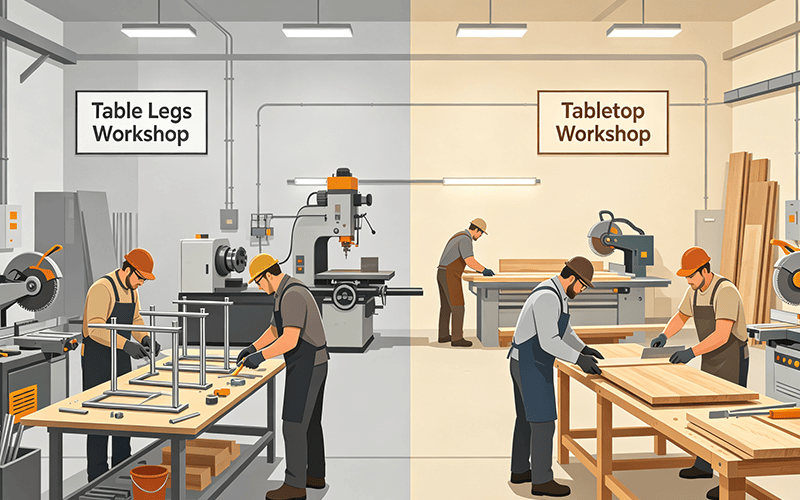
One Factory Produces the Tabletop, Another Produces the Base
A buyer may assume that two specialized manufacturers can easily coordinate production. In practice, each factory has its own production standards, tolerances, schedules, packaging methods and quality-control procedures. Small differences can create significant problems during final assembly.
Cross-Supplier Coordination Requires a Clear Responsibility Structure
If two factories are producing components for the same finished product, someone must take responsibility for dimensional compatibility, assembly, quality control and after-sales issues. Without a clearly defined coordinator, problems can quickly become difficult to resolve.
Two Practical Solutions When Components Come From Different Factories
There are two realistic approaches when a product requires components from independent manufacturers.
The first option is to complete the final assembly yourself. In this case, the buyer accepts responsibility for checking dimensions, matching components and resolving any compatibility problems. The buyer also needs to understand that after-sales responsibility can become more complicated when the final product depends on several independent suppliers.
The second option is to establish your own assembly or processing operation in China. This gives the buyer greater control over final production, quality inspection and component compatibility.
What is difficult is expecting two unrelated manufacturers to coordinate perfectly without additional investment, clear technical control or a responsible party managing the complete process.
Final Assembly By The Buyer
Receive the components separately and take responsibility for final assembly, dimensional matching, quality checks and any resulting after-sales issues.
Centralized Assembly In China
Use your own assembly or processing facility, or appoint a dedicated production partner, to coordinate components and establish one final quality-control point.
What Makes You A Stronger Buyer?
Chinese manufacturers generally respond better to buyers who demonstrate preparation, realistic expectations and long-term business potential. Before negotiating, consider:
- Research current market prices before requesting quotations.
- Compare several manufacturers instead of relying on a single supplier.
- Understand the quality differences between competing products.
- Prepare realistic order quantities and annual purchasing expectations.
- Understand common payment structures before negotiating terms.
- Provide clear product specifications instead of vague requirements.
- Explain whether the project is a one-time purchase or a potential long-term program.
Do Not Confuse Hospitality With Manufacturing Capability
A supplier offering airport pickups, dinners and extensive personal attention may create a strong relationship, but hospitality alone does not prove production capability. Evaluate the manufacturing operation itself:
- Is the factory actually producing the products you are purchasing?
- Can the supplier show current production rather than only finished showroom products?
- Does the factory have the equipment and workforce required for your products?
- Can the supplier maintain consistent quality across repeated orders?
- Are quality-control procedures clearly defined?
- Who is responsible when a quality problem occurs after delivery?
- Can the supplier support your expected order volume over the long term?
The strongest buyer is not necessarily the buyer who negotiates the hardest. It is the buyer who understands the market, knows what the factory needs and can offer a credible long-term business opportunity.
Successful sourcing from China is not simply about finding the lowest possible price. It is about understanding how manufacturers evaluate customers and building a commercial relationship that works for both sides.
Do your market research before negotiating quotations. Understand the difference between factories, trading companies and sourcing intermediaries. Be realistic about order quantities and payment conditions. And when you require customized production, recognize that deeper customization normally requires stronger commercial commitment.
It is also important to separate personal hospitality from actual manufacturing capability. A supplier can be extremely welcoming while still outsourcing production. Conversely, a highly capable factory may operate with a much more direct and production-focused communication style.
Finally, be careful when dividing one product between unrelated factories. If several suppliers are involved, make sure one party has clear responsibility for technical coordination, assembly and final quality control.
The goal is not to become the most demanding buyer in the market. The goal is to become a professional buyer whom reliable manufacturers want to work with repeatedly.
Manufacturers generally consider factors such as expected order volume, payment terms, product complexity, communication, purchasing experience and the potential for long-term cooperation. Company appearance alone rarely determines the final commercial relationship.
Not necessarily, but accepting quotations without conducting market research can make it difficult to know whether the price is competitive. Professional buyers normally compare suppliers, quality and pricing before confirming an order.
Payment structures vary by industry, supplier and relationship. Deposit-and-balance arrangements such as 30/70 or 40/60 are common starting points, but buyers should negotiate terms according to supplier risk, order size and the specific contract.
Most manufacturers can adapt products within their existing production capabilities. More extensive customization, dedicated tooling or major production changes generally require sufficient order volume and a credible long-term business commitment.
It can be done, but coordination becomes more complicated. Different factories have different tolerances, production standards and quality-control procedures. A buyer should establish clear technical responsibility and final assembly control before splitting production.
No. Airport pickups, dinners and personal attention can help establish relationships, but they do not prove manufacturing capability. Buyers should independently evaluate production facilities, quality systems, capacity, references and after-sales support.
Looking For A Reliable Furniture Manufacturing Partner In China?
Lohabour works with overseas retailers, designers, hospitality groups, developers and project buyers looking for reliable commercial furniture manufacturing in China. Our production capabilities cover sofas, beds, wood furniture, metal furniture and customized OEM solutions.
Discover Our Products