
China has developed one of the world's largest upholstered furniture manufacturing industries, with a broad network of large manufacturers, specialized factories and small and medium-sized workshops serving both domestic and international markets.
Custom upholstered furniture covers a wide range of products, including custom made sofas, sectional sofas, upholstered beds, mattresses, lounge seating and other upholstered furniture developed according to specific dimensions, materials and design requirements.
For international buyers, this manufacturing ecosystem creates significant opportunities. However, the large number of suppliers also makes factory selection more complicated. A company may have an attractive catalogue and professional online presence without necessarily having the production capabilities required for a demanding customized project.
The key is therefore not simply to find a furniture supplier in China, but to identify a manufacturer whose production system, materials, quality standards, communication and customization capabilities match your project.
Finding a reliable furniture factory in China is not about finding the cheapest quotation. It is about verifying whether the manufacturer can consistently produce the right product to the required specification.
This guide explains the current structure of China's custom upholstered furniture industry and provides a practical framework for evaluating manufacturers before placing samples, trial orders or large production orders.
Understanding China's Custom Upholstered Furniture Market
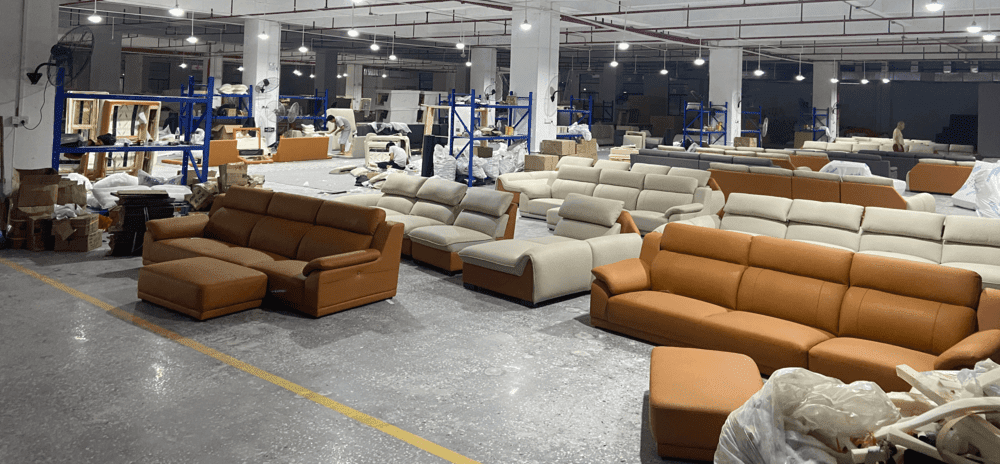
China's upholstered furniture industry includes a wide range of manufacturers, from large national brands to specialized factories producing customized furniture for international buyers.
The main product categories include upholstered sofas, functional sofas, traditional fabric sofas, leather sofas, upholstered beds, mattresses and various types of lounge furniture.
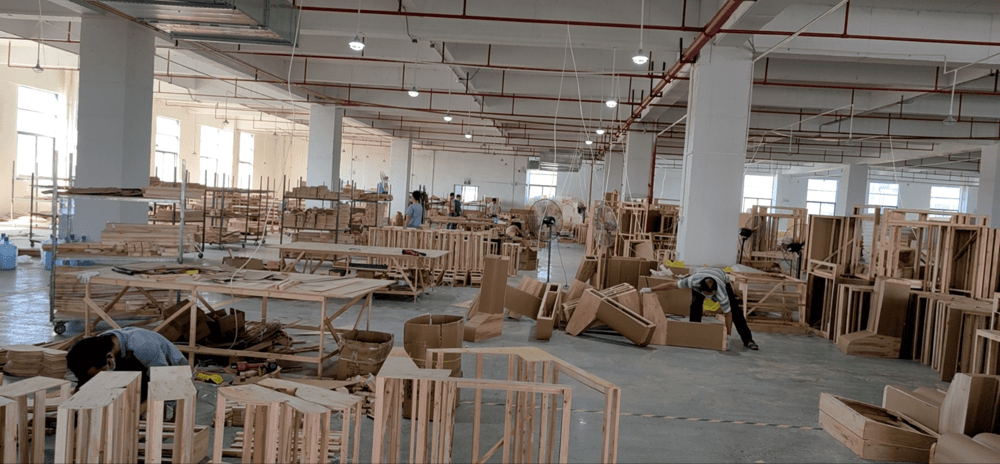
The production process remains relatively labor-intensive compared with some other furniture categories. Typical processes can include frame construction, webbing or spring installation, base-cloth application, foam cutting and bonding, upholstery cutting, sewing, covering, assembly and final inspection.
This combination of skilled craftsmanship and manufacturing infrastructure allows Chinese factories to produce both standardized furniture and highly customized products.
The market is also becoming increasingly influenced by customization, modular design, standardized components and more efficient production systems. Manufacturers are looking for ways to offer greater product variety without losing the efficiency of organized production.
Large Brands, Specialized Factories and Smaller Manufacturers
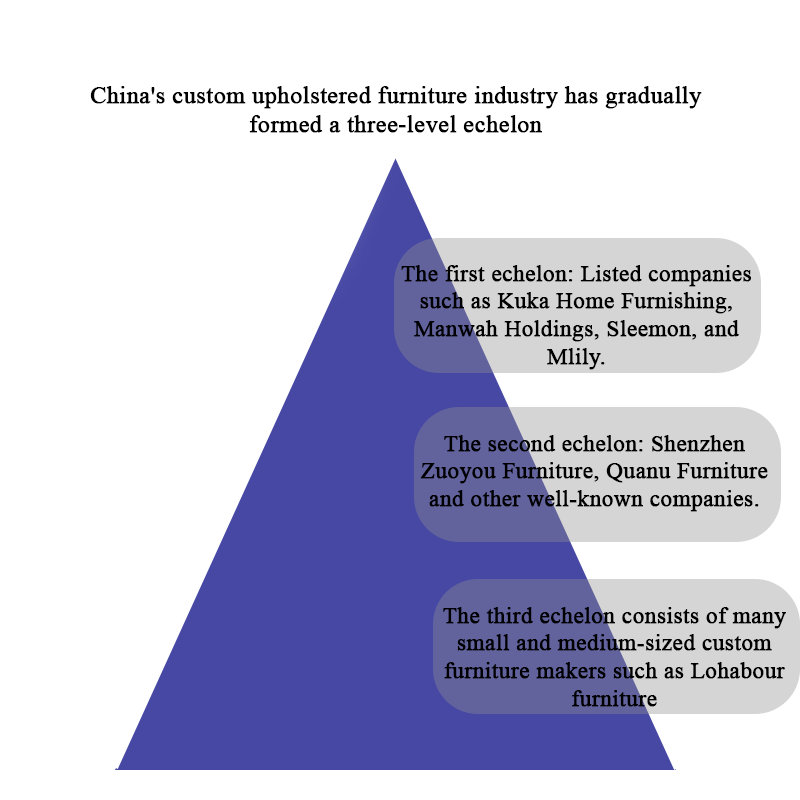
China's upholstered furniture industry can broadly be understood as a market containing several different levels of manufacturers.
Large furniture groups and established brands typically have extensive production facilities, strong distribution networks, large workforces and substantial investment in product development and manufacturing technology.
A second group consists of established regional manufacturers and specialized upholstered furniture companies. These factories may have significant production capabilities while remaining more flexible than large consumer-facing brands.
The third group consists of small and medium-sized factories and workshops. Some of these companies specialize in specific furniture categories or customized production and can offer attractive flexibility for smaller projects.
For international buyers, factory size should therefore not be the only selection criterion. A smaller specialized manufacturer may sometimes provide more responsive customization and communication than a large consumer brand.
The correct choice depends on the project. A large hospitality development with hundreds of rooms may require substantial production capacity, while a boutique hotel, restaurant or residential project may benefit more from customization flexibility and direct communication.
How China's Upholstered Furniture Industry Is Changing
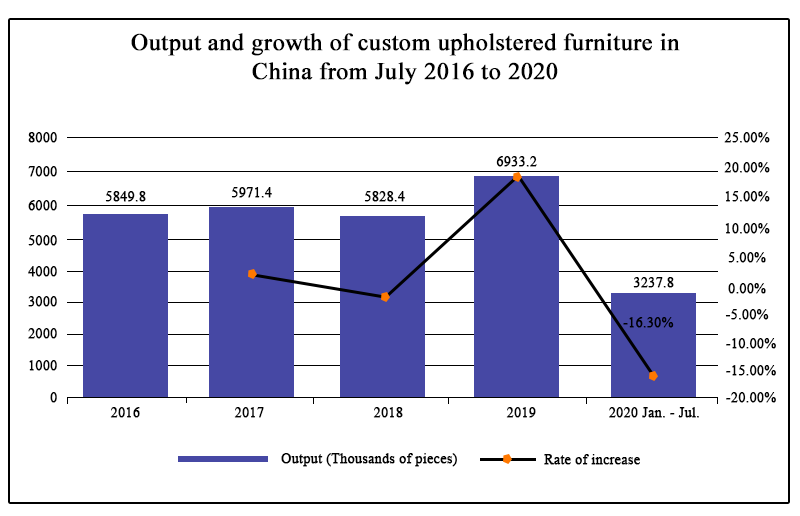
The Chinese upholstered furniture market has evolved significantly as consumer expectations, international competition and manufacturing technology have developed.
Customization has become increasingly important. Buyers want more choices in dimensions, upholstery, colors, configurations and materials rather than being restricted to standard catalogue products.
At the same time, manufacturers cannot economically produce every customized product completely from scratch. This has encouraged the development of mass customization, standardized components and modular production systems.
Modular furniture allows manufacturers to standardize internal components while offering greater variation in external configurations. This can reduce development time and make customized production more efficient.
Technology is also influencing the industry. Digital production planning, improved cutting systems, standardized quality-control procedures and more advanced factory management can help manufacturers handle larger numbers of product variations.
For international buyers, these developments mean that a factory's ability to manage customization efficiently can be just as important as its production capacity.
How to Check Whether a Furniture Factory Is Reliable
The first step in supplier evaluation is to determine whether the company is actually capable of manufacturing the products it is offering.
Ask the supplier for detailed information about its factory, production lines, major equipment, workforce, product categories and typical monthly production capacity.
Do not rely only on photographs provided by the supplier. If possible, arrange a factory visit or use an independent inspection service to verify the production site.
During an inspection, pay attention to whether the factory has dedicated areas for frame construction, foam processing, sewing, upholstery, assembly, quality control and finished-product storage.
A reliable manufacturer should also be able to explain its production process clearly. If the supplier cannot explain how your customized product will actually be manufactured, this may indicate that the company relies heavily on subcontracting or external suppliers.
Subcontracting is not automatically a problem, but buyers should understand which processes are performed internally and which are outsourced. This becomes especially important for quality control and production scheduling.
Evaluate the Factory's Customization Capabilities
A factory that produces standard sofas is not necessarily a good custom furniture manufacturer.
Customization requires the manufacturer to manage different dimensions, drawings, materials, colors, upholstery specifications and sometimes completely new structures.
Ask the factory whether it can work from technical drawings, CAD files, reference photographs or physical samples. The supplier should be able to translate your design requirements into production specifications.
You should also ask how the factory manages changes. A professional manufacturer should have a clear process for confirming drawings, material samples and prototypes before mass production.
For hospitality projects, customization may include room-specific dimensions, branded details, fire-retardant materials, commercial-grade fabrics, special stitching, integrated electrical functions or other project-specific requirements.
For residential furniture, customization may focus more on dimensions, comfort, upholstery, color and configuration. In both cases, the manufacturer should be able to clearly define what can and cannot be customized.
Check the Materials Inside the Sofa
The appearance of an upholstered sofa does not reveal everything about its construction. Two sofas can look almost identical while having very different internal structures and durability.
The frame should be evaluated carefully. Ask what type of wood or structural material is used, how components are joined and how the frame is reinforced.
The support system may include webbing, springs or other structural solutions. The choice can influence seating comfort, durability and long-term performance.
Foam density and filling materials should also be specified. Simply asking whether a sofa uses high-density foam is not enough. Buyers should request the actual specification when it is important to the project.
Upholstery materials should be evaluated according to the environment in which the furniture will be used. Residential furniture may have different requirements from hotel, restaurant, office or public-space furniture.
For commercial projects, buyers should also investigate abrasion resistance, stain resistance, cleaning requirements and applicable fire-safety standards for the destination market.
Never Skip the Sample and Quality-Control Process
For customized furniture, approving a sample before mass production is one of the most effective ways to reduce production risk.
The sample should be checked against the approved dimensions, drawings, materials and design specifications.
Inspect the frame, stitching, upholstery, foam, seams, legs, connectors and overall stability. The sample should also be tested for comfort and visual appearance when appropriate.
Color should be checked using the agreed material sample or reference rather than relying only on photographs. Lighting conditions can create significant differences between digital images and physical materials.
Once the sample is approved, the manufacturer should use it as a production reference. Any subsequent changes should be documented and approved before production continues.
For large international orders, pre-shipment inspection can provide another important quality-control stage. This allows buyers to identify problems before the furniture leaves the factory.
Compare Price, Capacity and Service Together
Price is important, but it should never be the only factor when selecting a custom upholstered furniture manufacturer.
A very low quotation may reflect lower-quality materials, limited quality control, lower labor standards or specifications that do not match the requirements of your project.
Instead of comparing only the final unit price, compare the complete quotation. Check the frame specification, foam, upholstery, hardware, packaging, customization, inspection, delivery terms and other included services.
Production capacity should also match your project requirements. A factory that can produce ten sofas per day may be excellent for a boutique project but unsuitable for a large hotel rollout.
Communication is another important factor. During the quotation and sample stage, pay attention to how quickly and accurately the supplier responds to technical questions. Poor communication before production rarely becomes better after the order is placed.
The strongest supplier is usually the one offering the best overall balance between quality, price, capacity, customization, communication and long-term reliability.
Build a Long-Term Relationship With the Right Factory
Once a reliable manufacturer has been identified, the goal should not simply be to complete one order. A strong factory relationship can become an important part of a long-term furniture supply chain.
Long-term cooperation allows the manufacturer to understand your quality standards, preferred materials, packaging requirements and design expectations more deeply.
For furniture retailers and hospitality groups, this can make future product development faster because the factory already understands the buyer's technical and commercial requirements.
Regular quality checks should still be maintained even when a supplier has performed well in the past. Production conditions can change, materials can change and new subcontractors may be introduced.
The most reliable sourcing strategy therefore combines long-term cooperation with continuous supplier evaluation.
Shortlist Custom Upholstered Furniture Factories
Before contacting manufacturers, define what your project actually requires.
- Define the furniture categories required.
- Prepare drawings, reference images or specifications.
- Determine required dimensions.
- Define upholstery materials and colors.
- Estimate expected order quantities.
- Set target delivery dates.
- Identify applicable destination-market requirements.
- Shortlist several potential manufacturers.
- Compare their product and customization capabilities.
- Request detailed quotations rather than catalogue prices only.
Verify the Manufacturer
A professional online catalogue is not enough. Verify the actual production capabilities of the supplier.
- Confirm the physical factory location.
- Check production areas and equipment.
- Verify frame construction capabilities.
- Inspect foam and filling processes.
- Check sewing and upholstery areas.
- Ask about internal and outsourced production.
- Review quality-control procedures.
- Check warehouse and finished-product storage.
- Discuss monthly production capacity.
- Verify previous international project experience.
Approve the Product Properly
A clear approval process helps prevent misunderstandings during customized production.
- Approve technical drawings.
- Confirm dimensions.
- Approve upholstery materials.
- Confirm foam and filling specifications.
- Approve colors and finishes.
- Produce a prototype or sample.
- Inspect the sample carefully.
- Document approved specifications.
- Confirm packaging requirements.
- Approve mass production only after the sample is accepted.
Complete Final Quality Control
International buyers should verify the finished furniture before shipment whenever possible.
- Check product dimensions.
- Inspect upholstery and stitching.
- Check frame stability.
- Verify colors and materials.
- Inspect cushions and filling.
- Check legs and hardware.
- Verify packaging protection.
- Compare finished goods with the approved sample.
- Document defects and corrective actions.
- Approve shipment only after final inspection.
The right Chinese furniture factory is not simply the supplier offering the lowest price. It is the manufacturer that can repeatedly deliver your required design, quality, quantity and specifications.
China offers an exceptionally large manufacturing ecosystem for custom upholstered furniture. From large furniture groups to specialized factories and smaller workshops, buyers can find manufacturers capable of producing sofas, upholstered beds, mattresses and other customized furniture for many different markets.
However, the size of the market also means that supplier selection requires careful evaluation. A professional website, attractive catalogue or low quotation is not enough to prove that a factory is suitable for your project.
The most important factors are manufacturing capability, material quality, customization experience, production capacity, quality control, communication and the supplier's ability to consistently reproduce an approved design.
For international buyers, the safest approach is to compare several manufacturers, verify their production facilities, discuss technical specifications in detail, approve samples and establish a clear quality-control process before committing to significant production volumes.
The growing importance of customization and modular production also creates new opportunities. Manufacturers that can combine standardized internal production with flexible external designs can respond more efficiently to the increasing demand for customized furniture.
For hotels, restaurants, residential developments and furniture retailers, the objective should therefore be to build a supply chain rather than simply find a supplier for one order. A reliable factory can become a long-term manufacturing partner that understands your specifications and helps you develop new products over time.
If you are looking for a custom upholstered furniture manufacturer in China for a residential, hospitality or commercial project, Lohabour can discuss your product specifications, materials, dimensions, customization requirements and production volumes with you.
Start by identifying several manufacturers that specialize in your required furniture category. Then verify their factory, production capabilities, customization experience, materials, quality-control procedures, export experience and previous projects. Request samples before placing significant orders.
Chinese upholstered furniture manufacturers commonly produce sofas, sectional sofas, lounge chairs, upholstered beds, mattresses, dining seating and other customized upholstered products. Capabilities vary significantly between factories.
Ask for the factory address, production photographs, manufacturing details and company information, then verify the physical production facility when possible. A factory visit or independent inspection can provide stronger verification than online information alone.
Yes. Many Chinese upholstered furniture manufacturers provide OEM and customized production. Depending on the factory, customization can include dimensions, upholstery, colors, materials, frame construction, configuration and other design details.
Yes. For customized furniture and larger orders, a prototype or production sample is highly recommended. It allows buyers to verify dimensions, materials, construction, upholstery, comfort and finishing before mass production.
Check frame construction, foam and filling processes, sewing and upholstery areas, assembly, quality control, warehouse organization, production capacity and whether important processes are performed internally or outsourced.
Factory size alone does not determine reliability. A smaller specialized manufacturer can sometimes offer excellent customization and communication. The important factors are actual production capability, quality systems, management, materials, capacity and proven project experience.
Compare the complete specifications rather than only the unit price. Check frame materials, foam, upholstery, hardware, dimensions, packaging, customization, production lead time, quality control and delivery terms to ensure that quotations are actually comparable.
Yes. China has extensive upholstered furniture manufacturing capabilities and many factories produce customized furniture for hospitality projects. Hotel buyers should pay particular attention to durability, fire-safety requirements, commercial-grade materials, quality control and production consistency.
Looking for a Custom Upholstered Furniture Factory in China?
Lohabour works with international buyers, hospitality projects, furniture retailers and residential developments. Our capabilities include customized upholstered sofas, sectional seating, upholstered beds and other furniture solutions developed according to specific project requirements.
Discover Our Manufacturing