

Instagram has become one of the world's most visible platforms for furniture sourcing. Every day, manufacturers, trading companies, sourcing agents, designers and furniture brands showcase products, factory videos, workshops and luxurious showrooms.
But behind these attractive images lies a question many furniture buyers never ask:
Who are you actually doing business with?
This article focuses primarily on B2B furniture sourcing, although many of the same principles also apply to individual consumers.
Whether you're a furniture retailer, interior designer, hotel purchasing manager, developer, wholesaler or project contractor, understanding how furniture suppliers operate on Instagram can help you avoid costly sourcing mistakes and build stronger long-term supply relationships.
Two Types of Furniture Buyers on Instagram
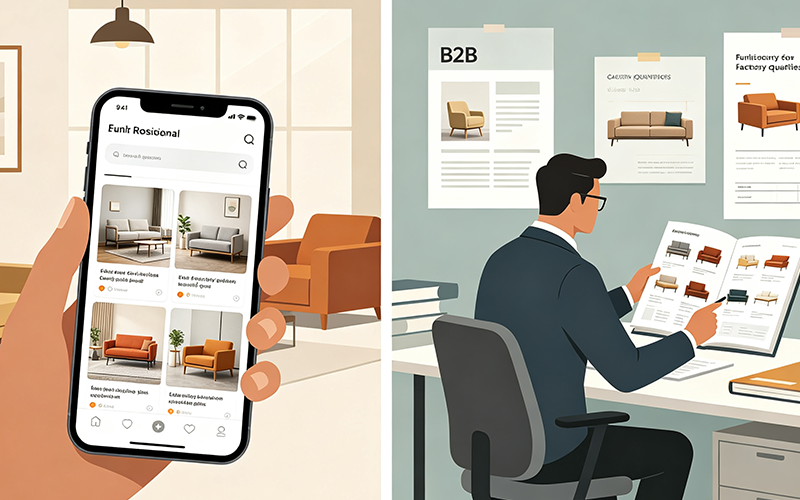
Most furniture buyers discovering suppliers on Instagram fall into two broad categories: B2C buyers purchasing furniture for their own homes, and B2B buyers such as furniture retailers, interior designers, wholesalers, hotels, developers and project contractors.
For B2C buyers, Instagram can be useful for discovering individual pieces, furniture brands and design ideas. For B2B buyers, however, the purchasing process is usually much more complex and involves specifications, quantities, quality control, packaging, logistics and after-sales support.
Regardless of the buyer type, Instagram is rarely the final sales platform. Instead, it normally acts as a marketing and discovery channel that directs buyers toward a company website, WhatsApp, Alibaba, email or another private communication channel.
The real transaction happens elsewhere.
Why Many Instagram Furniture Accounts Look Similar
Most furniture suppliers introduce themselves as manufacturers, exporters or furniture brands. Their content typically includes finished furniture, factory production videos, workshop processes, packaging operations and large showrooms.
However, one situation deserves closer attention. Sometimes buyers notice multiple Instagram accounts showing exactly the same showroom, different people presenting identical furniture in the same environment, or several accounts using almost identical product photography.
This is not necessarily fraudulent. In fact, there are legitimate business reasons why several accounts may appear to represent the same furniture source.
Nevertheless, it should encourage further investigation before a buyer places a large order or begins a long-term business relationship.
Understanding Multi-Account Marketing in China's Furniture Industry
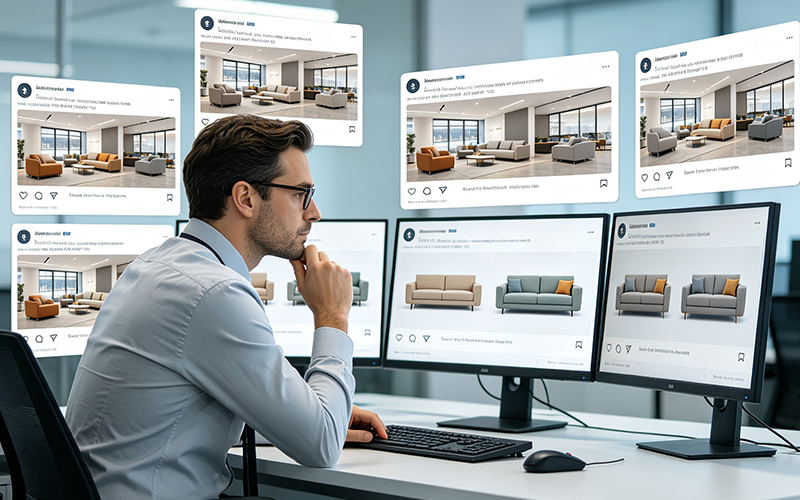
Operating multiple marketing accounts is a common strategy among Chinese suppliers. The objective is straightforward: maximize visibility across different keywords, countries, languages and product categories.
This strategy is not limited to Instagram. Similar approaches can also be found on B2B platforms such as Alibaba and Made-in-China, where a company may operate multiple accounts or have different sales teams targeting different markets.
Some companies divide their accounts by product category. Others allow different sales teams to operate independently while sharing the same factory resources, product database, production facilities or showroom.
This type of marketing matrix can help a supplier appear more frequently in search results and reach buyers in different markets.
As a result, what appears to be five completely different furniture suppliers may actually be one company, several sales teams working for the same company, or different businesses sharing the same production and showroom resources.
The important point is not to assume that multiple accounts automatically mean something is wrong. Instead, buyers should identify the legal company behind the account and understand the actual business relationship before placing an order.

When Multiple Accounts Show the Same Furniture Showroom
If different Instagram accounts repeatedly display the exact same furniture showroom, there are several possible explanations.
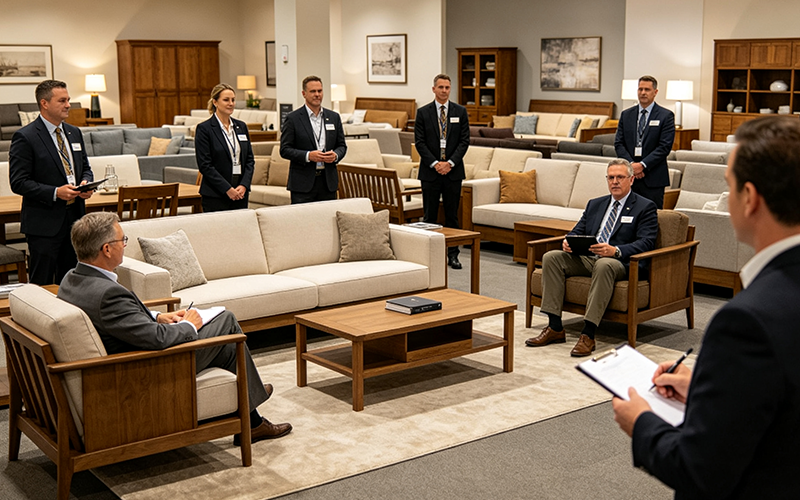
The showroom itself does not necessarily tell you who manufactured the furniture. A showroom can be used by one manufacturer, several manufacturers, trading companies, sourcing teams or independent sales representatives.
For this reason, buyers should separate the concept of a showroom from the identity of the actual supplier.
Multiple Accounts Operated by One Company
A furniture company may assign different sales teams to manage separate Instagram accounts targeting different countries, languages, customer groups or product categories. The accounts may use different names or sales representatives while sharing the same factory and product resources. This is relatively common and is not necessarily a problem.
Different Companies Sharing One Showroom
Shared showrooms are also common in China's furniture industry. A showroom may be jointly used by multiple factories, trading companies, independent sales teams or sourcing agents. Sharing showroom space allows participants to reduce exhibition and operating costs while presenting buyers with a much larger product selection. This business model can be legitimate, but buyers should clearly understand which company is actually selling and manufacturing the furniture.
A Large Furniture Showroom Doesn't Always Mean a Better Supplier
Many Instagram accounts proudly advertise claims such as "5,000㎡ showroom", "10,000㎡ experience center" or "largest furniture showroom". Large showrooms certainly create a strong impression, but showroom size does not automatically prove manufacturing capability, product consistency or after-sales service.
- Who owns the showroom?
- Who actually manufactures the furniture?
- Who will receive your payment?
- Which legal company signs the contract?
- Who is responsible for quality control?
- Who will handle warranty claims?
- Who will solve problems after delivery?
What to Verify Before Placing a Furniture Order
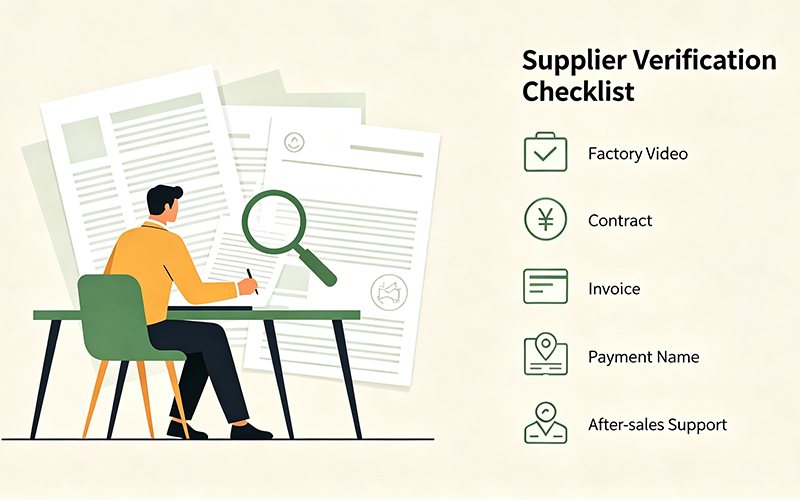
For B2B buyers, supplier verification should happen before signing a contract or transferring a significant payment. A professional supplier should be able to clearly explain its company structure, manufacturing resources and responsibility for quality and after-sales support.
- Verify the legal company name behind the Instagram account.
- Confirm whether the company is a manufacturer, trading company, sourcing office or sales representative.
- Ask whether the showroom is privately owned or shared.
- Request recent factory videos rather than relying only on showroom content.
- Confirm where the furniture will actually be manufactured.
- Check whether invoices, contracts and payments are issued under the same company name.
- Understand who is responsible for quality control before shipment.
- Confirm who will provide after-sales support after delivery.
- Compare communication and information provided by different company representatives.

The goal isn't to avoid suppliers with multiple accounts or shared showrooms. The goal is simply to know exactly who your long-term business partner is.
Look Beyond the Showroom
Instagram is an excellent platform for discovering furniture suppliers in China, but attractive photography, factory videos and impressive showrooms should never replace proper supplier verification.
The best supplier isn't necessarily the company with the largest showroom, the highest number of Instagram accounts or the biggest product catalogue. The right supplier is the one that provides transparency, stable manufacturing capability, reliable communication, consistent quality and dependable after-sales support.
For B2B buyers, successful furniture sourcing isn't simply about finding attractive products at a competitive price. It is about establishing a supply relationship with a company that can consistently manufacture, inspect, package and deliver the required products.
The more important the project, the more important it becomes to understand exactly who stands behind the furniture you are buying.
No. An Instagram furniture account may represent a manufacturer, trading company, sourcing office, independent sales team or marketing agency. Buyers should verify the legal business entity and understand who is actually responsible for the order before making a payment.
Not necessarily. A large showroom may display products from several factories or companies. Buyers should verify who actually manufactures the furniture, where production takes place and which company will be responsible for quality control and after-sales service.
Start by requesting the company's registered business name, factory address, production information, recent factory videos, relevant certifications, project references and details about quality control and warranty support. The company named on your contract and invoice should also be clearly identified.
Instagram is primarily a discovery and marketing platform. B2B buyers should use it to discover suppliers, then complete proper supplier verification before signing contracts, placing large orders or making significant payments.
Many companies use multiple accounts to target different countries, languages, product categories or customer groups. This is a common marketing strategy and does not automatically indicate fraud. Buyers should simply confirm whether the accounts represent the same legal company or different businesses.
Looking for a Reliable Furniture Manufacturing Partner in China?
At Lohabour, we specialize in commercial furniture solutions for hotels, restaurants, apartments, offices and wholesale distributors. Our furniture manufacturing capabilities across sofa, bed, wood furniture and metal furniture allow us to support OEM projects with consistent production, flexible customization and dependable after-sales support.
Contact Us